How the SOAS Library archive helps bring teaching to life


The archives at the SOAS Library help my MA Gender Studies students uncover the past in powerful ways - your support keeps this transformative work alive.
As a Lecturer in Gender and Sexuality at the SOAS Centre for Gender Studies, I convene the MA in Gender Studies. In class, we confront the political, epistemological and ethical implications of conducting research from a feminist standpoint.
I have a personal interest in feminist and queer archives, so I teach the ‘archives’ methods week on the course. I’ve been organising an ‘archives workshop’ at the SOAS Special Collections for the last two years, and it’s one of my favourite teaching activities.
Teaching how to approach archival materials through a feminist method
Bringing students to the Special Collections was a natural decision given its holdings and its proximity. I chose SOAS Special Collections rather than, say, the Feminist Library, to, on the one hand, look at materials from feminist movements outside of the ‘West’, and second, to elicit student reflections on how to approach archival materials and histories that are not straightforwardly ‘feminist’ or ‘queer’ and are, at times, ‘un-feminist’.
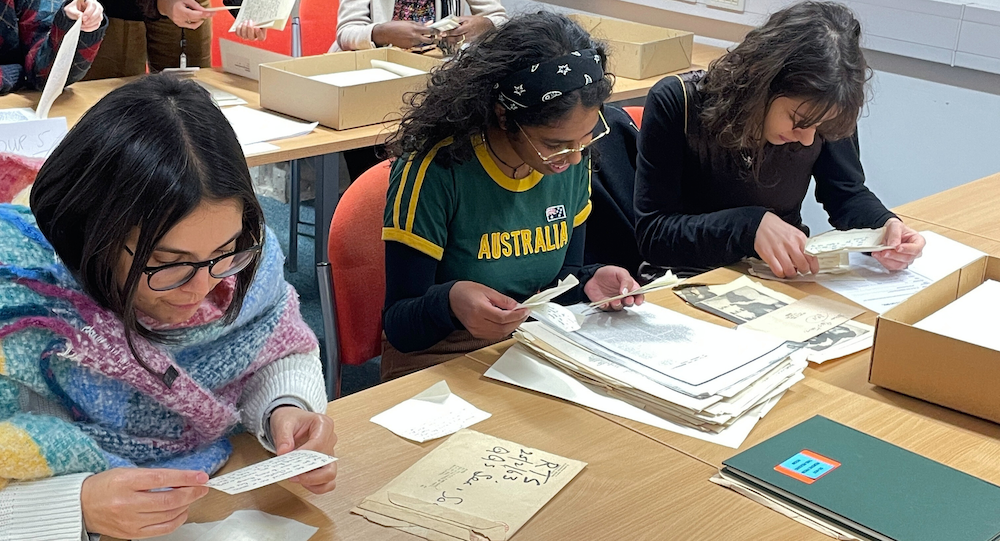
For instance, we looked at materials from women missionaries travelling to colonised countries and their attached materials – photographs, personal letters – with the aim to ‘civilise’ the colonised masses. These histories, violent as they are, are part of the historical record.
During the workshop, the students, librarians, and I had generative discussions on what it means to approach these archival materials through a feminist method.
How my students use the archives
We have an excellent team at SOAS Special Collections who were enthusiastic about hosting our students and extremely helpful in signposting collections and materials that would be relevant to Gender Studies students. The students come into the Special Collections Reading Room and learn about:
- The logistics of archival research: How do you request materials? How do you handle them?
- The diversity of materials in the archive, which includes photos, personal letters, documents, and magazines - the possibilities are endless!
- What it means to approach archival research from a ‘feminist’ method.
Many students found the experience quite moving. One student reflected: “When looking through a set of handwritten notes asking for advice, it was as if I could feel the emotion within them.”
Intellectually, the tour demonstrated the potential of archives as a site of resistance in a way I wouldn’t have been able to grasp from the readings alone.
Another student similarly observed: “The physicality of the materials was moving, holding something with a tangible connection to the past. Intellectually, the tour demonstrated the potential of archives as a site of resistance in a way I wouldn’t have been able to grasp from the readings alone.”
What makes the SOAS Library stand out
SOAS Library stands out due to our specialist teams and the depth and breadth of the Collections. Simply put, the SOAS Library and Special Collections hold materials (and histories) that are unique to the London, if not the British landscape. Exceptional in the truest sense of the word.
Our fantastic Library and Special Collections teams are extremely knowledgeable and helpful. Whether you want to coordinate a visit or need guidance on navigating the collections, the staff are always more than enthusiastic with their support.
If I had to pick one item in the Special Collections
It’s difficult to choose! The item that elicited the most discussion in this year’s workshop was a letter from Eva Dykes Spicer, a British Missionary Educator, to a close female friend. The letter insinuated a romantic relationship between the two but without any of the language or identity we have come to attach to modern queer and lesbian identity. It was a fun piece of archival gossip that also led to a discussion on how to navigate queer ‘desires’ in the archive.
With your support, we hope to raise £35,000 so we can continue to provide vital resources, study spaces, and expert research assistance to all who rely on the SOAS Library.