Learning by doing: My art internship archiving Chu Teh-Chun’s legacy


MA in History of Art and Archaeology student Annie Wong shares their internship experience and how it helped them translate theoretical knowledge into practical application and provided archival experience for their career.
Coming from the commercial art industry, I have always believed in the value of connecting art-historical discourse with practical engagement. My conviction is that adapting academic knowledge to working contexts is key to launching a more inclusive and relevant art historical discourse.
This belief is what motivated me to pursue my MA in History of Art and Archaeology at SOAS, and it was further affirmed during my recent internship at the Fondation Chu Teh-Chun.
Learning by doing
In the summer of 2025, I had the privilege of spending four weeks in Geneva working as a research assistant at the Fondation. This non-profit organisation is dedicated to preserving the legacy of Chu Teh-Chun, who, after migrating to France in 1955, became a bridge himself between Chinese tradition and Western abstraction. I saw this internship as an opportunity to echo my own research interests in modernism of Chinese art and diasporic artists in Europe.
My role at the Fondation was twofold: to design an archival database framework for a collection of artists' correspondence, and to document and research the materials.
Putting theory into practice
My prior professional experience and academic training at SOAS enabled me to work confidently with paper materials, especially in tasks involving letter transcription and research. Yet, developing a conceptual framework for a letter database introduced a new challenge. It was here that the wide range of theories and methodologies I engaged with at SOAS provided the intellectual scaffolding for rethinking what such a database could and should do.
I had to ask myself: How and why is art history read? I designed a framework that treats these letters not just as objects.
I had to ask myself: How and why is art history read? I designed a framework that treats these letters not just as objects, but as nodes in a complex historical network, viewable through multiple lenses: chronology, actors, geography, and materiality. It was an exciting exercise in imagination, visualising the potential narratives these raw materials could hold.
It is also apparent that textbook theory is not a ‘copy-paste’ solution. I had to revisit a way of ‘historicising’ the letters that was both academically sound and contextually relevant for the Fondation. This intellectual ‘translation’ demanded flexibility, sensitivity, and thoughtful mediation that are invaluable skills both in academic and professional settings.
Nuancing the narrative for future generations
This project offered me intimate access to primary sources that sit at the heart of my research interests. Reading these letters, firsthand accounts from actors involved in the modernism of Chinese art, was a revelation. It became clear that an individual actor’s perspective, particularly concerning struggles and difficulties, sometimes diverges from broader, established narratives.
How we perceive, tag, and archive these stories defines how they will be understood by future generations.
Crucially, the perspectives held then may not perfectly align with the ethical frameworks of the present. This realisation highlights the ethical responsibility we have as researchers. How we perceive, tag, and archive these stories defines how they will be understood by future generations.
My time in Geneva, outside of my internship
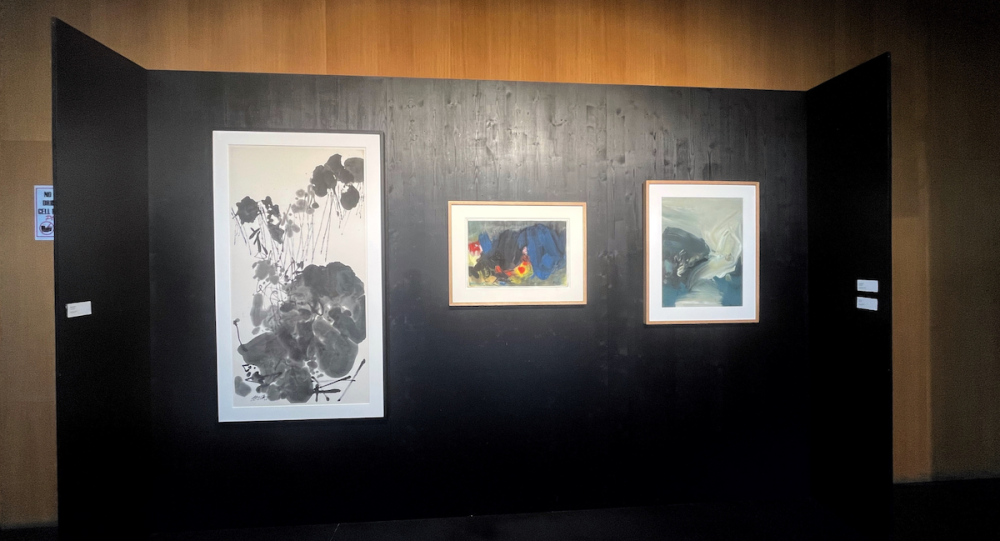
Beyond the archive, my time in Geneva was incredibly enriching. I attended an exhibition on the artist’s works on paper, where I witnessed how the curatorial approach cultivated a dialogue on his Chinese heritage for a largely Western student audience.

Meanwhile, my weekend hikes in the nearby Alps offered a grounding counterpoint to the artist’s abstract practice that was itself partly inspired by the striking scenery.
The trust and freedom the Fondation entrusted in me as a SOAS student made this cross-pollination of ideas possible. This internship served as a proof of concept: that translating theoretical knowledge into practical utility is what keeps academic research alive and relevant. I leave Geneva equipped with archival experience and a renewed commitment to my research path.
About the author
Annie Wong previously worked as a Senior Specialist in the Modern Chinese Paintings department at Sotheby’s Hong Kong before completing her MA in History of Art and Archaeology at SOAS. Her current research explores modernism in Chinese art, diasporic Chinese artists, and the role of patronage in artistic production.