My childhood inspired me to study migration and diaspora studies - and a scholarship made that possible


Our Scholar Spotlight focuses on Apala Mandal, a Felix Scholarship recipient, who came to London to pursue an MA in Migration and Diaspora Studies.
Alumna Apala Mandal moved to London in 2022 to study her MA Migration and Diaspora Studies at SOAS. Inspired by her own experiences in childhood moving from India to the US and back, SOAS was her top choice due to the university's decolonial focus.
This summer, Apala shared with us the impact of her scholarship that initially brought her to London and what she's up to now as a PhD candidate at The London School of Economics and Political Science (LSE).
Why SOAS?
I migrated a lot when I was a child - my parents were students in the US for the first decade or so of my life. When we moved back to India, we moved to a state with a culture very different from the one we practiced back home. Questions of belonging and non-belonging, and questions of mobility and stasis have always been intimately tied into my relation with the world. SOAS is one of the only institutions in the world to provide a standalone course on Migration and Diaspora Studies, one that I feel accords this area of study with the nuance and interdisciplinarity it merits.
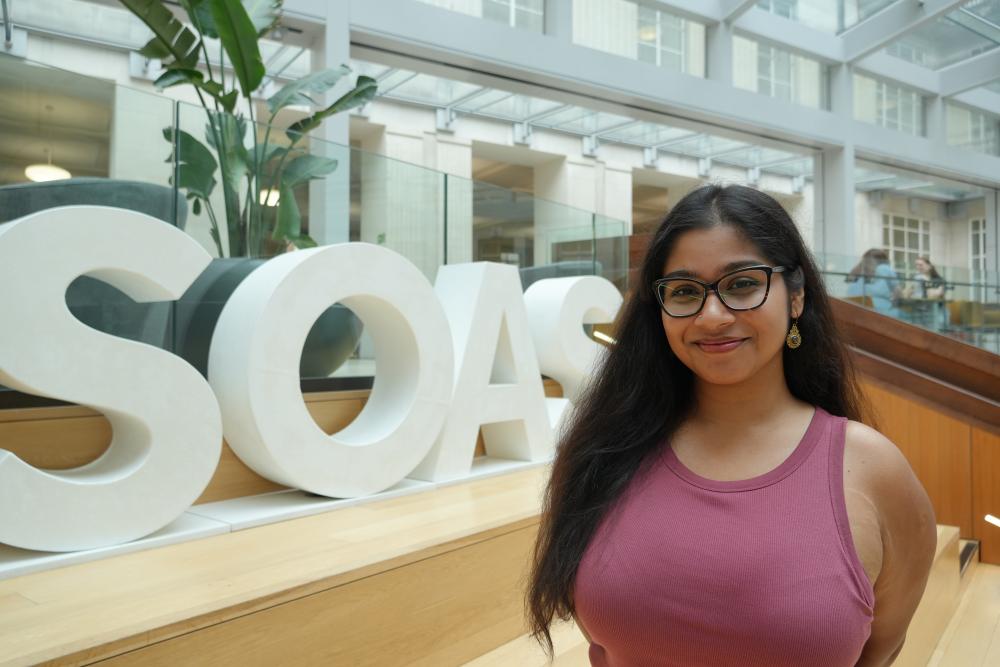
I enjoyed all my time in the classroom, where a decolonial approach was at the heart of our efforts and not a footnote or an addendum. Studying under some of the greatest, most engaged educators I have ever met, I did more than just learn my discipline.
Migration is a central concern, all around the world, and I feel lucky to have studied the phenomenon in an educational context that privileges considerations of cross-cutting precarity, historic inequality, and radical reimaginations.
I noticed how they created nurturing classroom spaces, how they opened up conversations about inclusivity and mental health, how they diversified assessment and grading so that each student could explore their passions, and how much energy and thought they put into the pastoral parts of teaching as well. I hope to take all of what I was able to have at SOAS and bring it to the classrooms I will teach in someday.
My scholarship brought me to London
While I was elated to receive an offer of admission from SOAS, I did not allow myself to celebrate. I knew that my family could not afford an overseas education, especially since I have a younger sister with her own academic aspirations. It was only when I received my scholarship offer that I really began coming to terms with this extraordinary opportunity. Without the support of the Felix Scholarship, I would never have been able to come to London.
Life after SOAS
After I completed my MA, I flew back home to India. I’d already started planning my PhD applications, speaking with mentors and alumni through SOAS networks and contacting prospective supervisors. I spent the winter sending admission and funding applications for my doctoral studies, while also balancing two part-time research roles. The first in an NGO that seeks to bring equity in access to Indian higher education for marginalised caste students, and the second in a research centre focused on gender and sexuality studies.
This past September, I started my PhD in Anthropology at the London School of Economics, with funding from LSE and the UK’s Arts and Humanities Research Council. I have had a fantastic first year, and have recently upgraded to fieldwork status. I’m going to start my fieldwork in the autumn— I will move to Manchester for a couple of years, to study how migrant Indian mothers teach their children to value, embody and reproduce culture. My long-term goals include going back to India to teach as a university professor.
Image credit: Krzysztof Hepner via Unsplash.