Heritage as Parody: Temple Rituals and the Reenactment of Ancient Performing Arts in Nara

Key information
- Date
- Time
-
5:00 pm to 7:00 pm
- Venue
- Russell Square: College Buildings
- Room
- Khalili Lecture Theatre (KLT)
- Event type
- Lecture
About this event
This lecture ventures into the realm of Japanese sonic imaginations, unveiling hidden connections between heritage discourses and the materialization of nostalgia through sound.
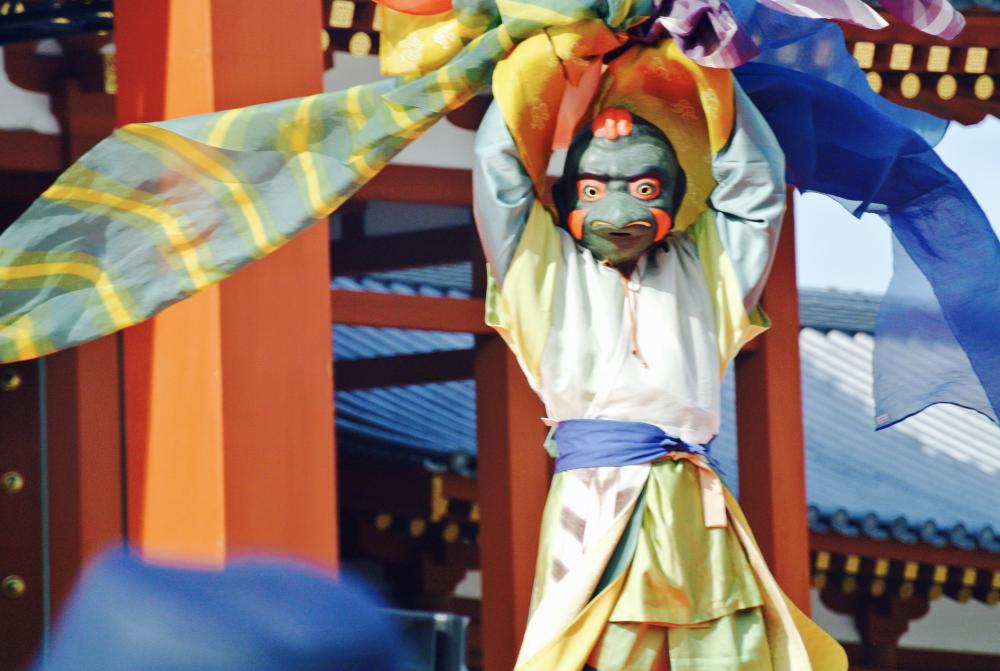
Assumptions about how ancient Japan might have sounded like have a long history. At least since the 19th century, major Buddhist temples and national stakeholders started to organize public spectacles featuring ancient performing arts, presented as precious representatives of the country’s glorified past. Nara, “the hometown of national history” (Ruoff 2014) and the idealized terminus of the Asian Silk Roads, was the perfect backdrop for such celebrations; its sacred sites featured regularly as the cradle of Japan’s musical history. Functioning like an “acoustic palimpsest” (Daughtry 2017), Japanese courtly and ceremonial music (Gagaku) was especially sought after, and it became the most suitable source of sonic materials. To this day, Gagaku frames most attempts to “reconstruct” or “reenact” ancient performing arts, but these experimentations remain largely unexamined.
The lecture combines historical and music analysis with ethnography, following closely the activities of Gagaku scholars and musicians who worked to reenact Gigaku, a long-lost Asian masked pantomime with music. It presents two case studies in which Gagaku and Gigaku are featured prominently: Yakushiji’s Grand Festival of Genjō Sanzō, and Tōdaiji’s memorial celebration of its founder. Contemporary re-enactments of ancient performing arts are what Gérard Genette called “parodies”, transformations of pre-existing texts in which “distortion is indispensable” (Genette 1997). My approach reconciles philological and anthropological interpretations of this parodical, paradoxical heritage, interpreting it as the product of a desire to design a future for the sounds of the past.
A wine reception will follow the event.
Registration
This event is free, open to the public, and held in person only.
Organiser
This event has been organised by the SOAS Centre for the Study of Japanese Religions and SOAS Japan Research Centre.
About the speaker
Andrea Giolai is University Lecturer in Ethnography and Performing Arts of Japan at Leiden University. Much of his research traces how textual, aural, and bodily practices create heritage discourses about courtly and ceremonial music (Gagaku) in contemporary Japan. Recent projects also explore the impact of environmental change on traditional musical instruments, and the Japanese sound art scene.
His research has been published in journals like Asian Anthropology (2019) and the Journal of Religion in Japan (2020), and in edited collections, including Rethinking Nature in Post-Fukushima Japan (Edizioni Ca’ Foscari 2018); the Bloomsbury Handbook of Japanese Religions (2021); and Gagaku. The Cultural Impact of Japanese Ceremonial Music (De Gruyter 2025). He co-edited Textual Heritage. Locating Textual Practices Across Heritage and the Humanities (Berghahn 2026) and is working on a monograph on how Gagaku shaped contemporary understandings of the sound of Japan’s ancient past.
Contact
Contact email: centres@soas.ac.uk
Image gallery