'Rabindrasangeet and its Performative Afterlives during the Marxist Cultural Movement of 1940s Bengal'

Key information
- Date
- Time
-
5:00 pm to 7:00 pm
- Venue
- SOAS, Main Building
- Room
- G52
About this event
Join us for the lecture, 'From Spiritual Elite to Political Praxis: Rabindrasangeet and its Performative Afterlives during the Marxist Cultural Movement of 1940s Bengal'.
This lecture examines how Rabindrasangeet, long associated with spiritual introspection and elite bhadralok culture, was transformed into a mode of political expression during the Marxist Cultural Movement in Bengal in the 1940s. Moving beyond the dominant assumption that Rabindrasangeet was apolitical (or incompatible with public culture), the lecture traces how the genre entered spaces of protest, mobilisation, and collective performance alongside Ganasangeet (Songs of the People).
Drawing on archival accounts, memoirs, performance histories, and film examples, the lecture focuses on organisations such as the Youth Cultural Institute and the Indian People’s Theatre Association (IPTA), where Rabindrasangeet was reworked through communal singing, and new performance contexts including streets, political meetings, refugee camps, and student gatherings.
Particular attention is given to performers such as Debabrata Biswas, Suchitra Mitra, Kalim Sharafi, and Jyotirindra Moitra, whose practices unsettled the genre’s established aesthetic codes and expanded its political reach.
The lecture also explores Rabindrasangeet’s cinematic afterlives in the work of Ritwik Ghatak, where the songs articulate themes of famine, displacement, partition, and political disillusionment. At the same time, it addresses the tensions within the Marxist Cultural Movement itself, especially the persistence of bhadralok cultural hegemony, which eventually contributed to Rabindrasangeet’s re-sacralisation as elite 'high art' after the 1950s.
By foregrounding performance, circulation, and reception, the lecture argues that Rabindrasangeet’s political potential lies not in fixed meanings but in its capacity to be repeatedly reactivated within moments of social crisis - an afterlife that continues to shape practices of musical dissent in Bengal today.
Seminar series
The SOAS Public Music Research Seminar Series is a valuable forum for ethnomusicology and related fields in London, bringing rising and established scholars to share innovative music research with SOAS audiences.
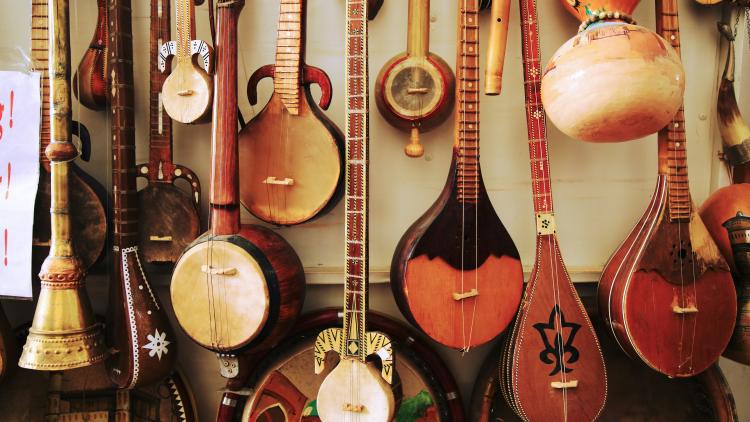
Image credit: Fey Marin via Unsplash
About the speaker
Sahana Bajpaie is an internationally acclaimed, award-winning performance artist and practice-led researcher specialising in Rabindrasangeet and Bengali folk music. She holds an AHRC-funded PhD from King’s College London on the politics of performance in Rabindrasangeet. She is Senior Teaching Fellow in Bengali and South Asian Studies at SOAS University of London and currently a Leverhulme (ECR) Postdoctoral Fellow at the School of Music, University of Leeds. Her work bridges music, politics, cultural nationalism, and public performance across South Asia and its diasporas.