Why Socioeconomic Conditions Matter in Shaping State Institutions that Propel or Hinder

Key information
- Date
- Time
-
6:00 pm
- Venue
- SOAS SWLT & online
- Room
- Senate House - Wolfson Lecture Theatre
- Event type
- Seminar
About this event
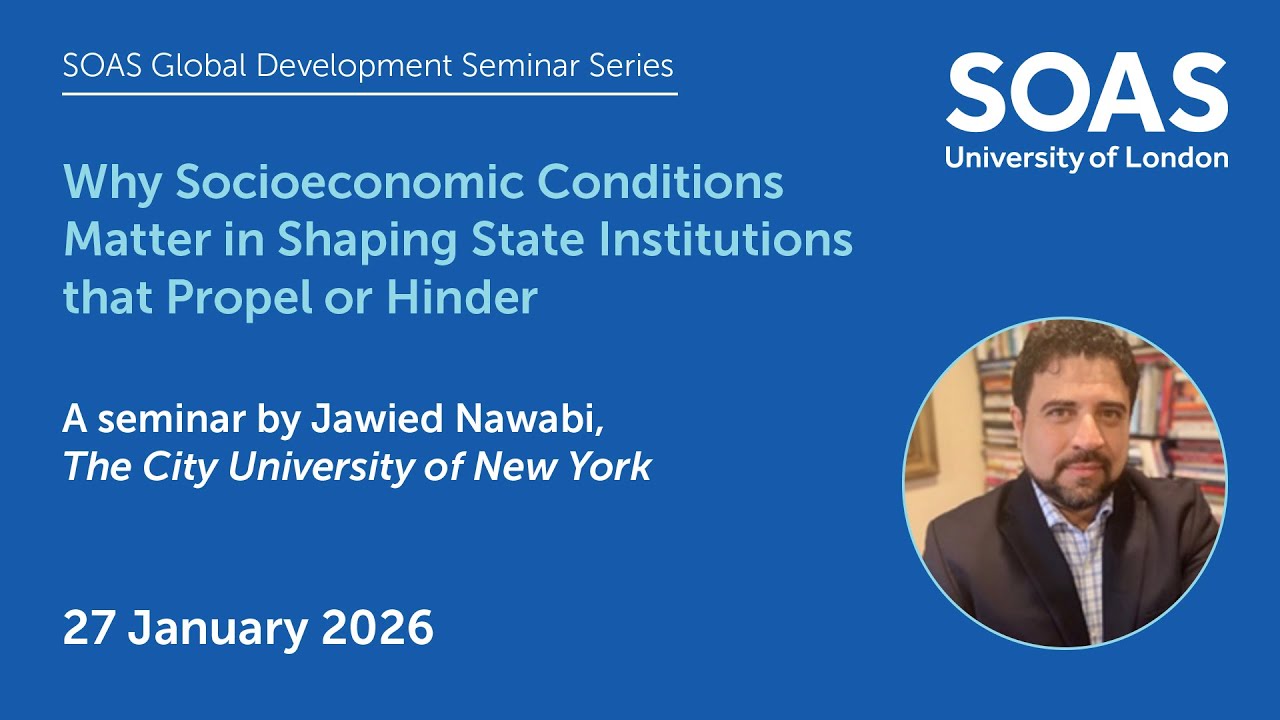
In spite of humanity’s significant advancements in science, technology and institutionalization of universal human rights conventions in the last seven decades, many countries are still failing to achieve successful development results.
As a result, enormous levels of inequality, poverty, and malnutrition prevail. The book, Why States Matter in Economic Development: The Socioeconomic Origins of Strong Institutions, by Professor Jawied Nawabi, focuses on the role of the state in the political economy of development, tracing the socio-economic origins of effective state institutions from a comparative historical-institutional perspective. Drawing on the case studies of South Korea, Brazil, India, Spain, France, and England, the study looks at how good state institutions form, and why these are central to the socioeconomic advancement of their populations.
The book contends that effective developmental states are those in which state actors are able to effectively diminish and co-opt the power of the country’s landed elites during the early years of state building. Effectively, the power balance between these two classes determines the developmental trajectory of the state. Considering agrarian reform as the foremost indispensable policy tool to open conditions for positive changes in effective taxation, education, healthcare, and strategic sustainable industrial policies, this analysis offers a significant contribution to the literature on the sociology of institutions and the political economy of development.
Registration
Attendance is free, but registration is required.
Contact us
- Email: devtrac@soas.ac.uk
This event is part of the SOAS Global Development Seminar Series.
Photo: Primrose and Makause, Johannesberg. Source: Unequal Scenes - South Africa
About the speaker
Jawied Nawabi
Jawied Nawabi is full Professor of Social Sciences, teaching Sociology, Economics, and International Studies - at the City University of New York - Bronx Community College, where he has taught and conducted research for the last 18 years. He is the author of the book, Why States Matter in Economic Development: The Socioeconomic Origins of Strong Institutions (Routledge Press 2024) which is a comparative socioeconomic and historical study of state formation of three European states (England, Spain, and France) and three non-European states (India, Brazil, and South Korea). He has presented parts of his research at various research network conferences, namely the World Interdisciplinary Network for Institutional Research (WINIR) in Brazil, Boston, and Indiana. Most recently, he presented at the Association of Heterodox Economists conference in Kings College, London.
He is the co-editor of Real-World Globalization textbook readers, published by the Boston Economic Affairs Bureau, where has published several articles on topics of economic development, sociological roots of development, and political economy. One of his journal articles was published in the Journal of Global South Studies, titled, Afghanistan: The Making and Unmaking of a Modern State. He is a first-generation Afghan American immigrant. He earned his Ph.D in Sociology and Masters in Economics from The New School for Social Research (NSSR) and a B.A. in Philosophy from SUNY Stony Brook University in New York. He is fluent in Farsi/Dari and Hindi/Urdu, and conversational in Spanish, Dutch, and Portuguese.
Chair:
- Carlos Oya, Professor, Department of Development Studies, SOAS University of London