SOAS researchers spark global debate on auction of Buddhist relics

Earlier this month, Sotheby’s Hong Kong postponed an auction just hours before it was to take place. “The Piprahwa Gems of the Historical Buddha” had attracted keen global attention due to their highly sacred value for Buddhists and their colonial-period acquisition.
This debate was sparked after SOAS Professor Ashley Thompson and PhD student Conan Cheong published an article in the Journal of Buddhist Ethics, and an op-ed in Religion News Service. The journal paper, titled “Selling the Buddha’s Relics”, analysed the violence inherent in the colonial acquisition process and its perpetuation in the planned Sotheby's sale.
Specialists of Buddhist arts and cultures, the scholars highlighted Buddhist understandings of relics both at the time of their burial and today, all of which perceive the looting or sale of Buddha relics as a serious ethical violation. They also highlight the exhibition of these gems in high-profile international museums before the auction, which boosted international interest in the relics.
The Piprahwa relics
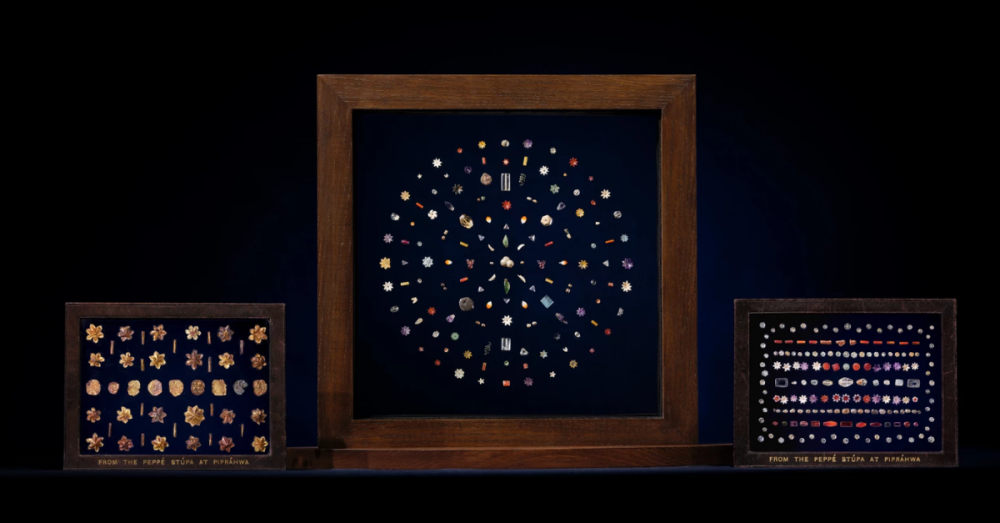
The Piprahwa relics were excavated from a Buddhist funerary monument, or stupa, in modern-day Uttar Pradesh by colonial landowner William Peppé in 1898. Found within reliquaries containing fragments of bone and ash were hundreds of rubies, pearls, topaz and other gems.
An inscription on one of these containers indicates that the relics within were deposited by the descendants of Siddhartha Gautama, the historical Buddha and founder of the Buddhist religion. The inscription further identifies the relics within as belonging to the Buddha himself.
Why this sale was controversial
Following their excavation, William Peppé separated the gems and precious items from the bones and ash, which had all been found together in the reliquaries. The finds were then transferred to the British colonial government, as required by the 1878 Indian Treasure Trove Act.
The British colonial government made a diplomatic gift of the bones and ash to King Rama V of Siam, while depositing the reliquaries and the bulk of the precious gems in the Kolkata Museum. A portion of the gems were however marked as “duplicates”- a colonial term widely criticised by academics today- which allowed Peppé and his descendants to maintain ownership of them. It is this portion of the gems which were due for sale on 7 May.

Professor Thompson and Cheong argued that Sotheby’s and the Peppé family were not only commodifying these relics, sacred to Buddhist devotees, but trading on this sanctity to increase their sale price at auction. Citing Sotheby’s own promotional materials, they note that rather than address “the ethical implications of auctioning the śarīra [relics] of the Buddha to the highest bidder”, the auction house instead highlighted their unique sacred nature “to drive up the hammer price”.
Outside of these spiritual implications, the paper outlines the practice of “imperial archaeology” that saw the Piprahwa gems pass into ownership of the Peppé family. Not only were the gem relics made inaccessible to Buddhist communities for over a century, they argue; their auction for the financial benefit of the Peppé family would continue this extractive colonial tradition.
The global debate
The paper by Thompson and Cheong attracted widespread media attention, informing reporting and commentary from the Guardian, the BBC, the New York Times, the Thai Standard, the Phnom Penh Post, Cambodianess and the Sri Lankan Sunday Times. Shortly after the appearance of the international reporting, the Indian government issued a legal notice to Sotheby’s, threatening action due to the "inalienable religious and cultural heritage of India and the global Buddhist community” and the sale’s alleged violation of both Indian and international law.
The Piprahwa case demonstrates the perpetuation of colonial violence in our day.
Following consultations between Indian officials, Sotheby’s and the Peppé family, the auction was postponed, with ownership of the relics now under legal and ethical scrutiny. Speaking about their efforts to scrutinize this sale, Professor Ashley Thompson said:
"The Piprahwa case demonstrates the perpetuation of colonial violence in our day. This was not lost on Buddhist communities who do not typically follow Sotheby's sales but who made their objections heard loud and clear. Nor was it lost on the Indian government which has devoted substantial energy to making a strong argument for restitution to India and to Buddhist communities worldwide."
Imagery: Sotheby's Hong Kong