Trends and patterns in family life since the Chinese Communist Revolution revealed in new book


The first detailed study on sex, marriage and intimacy in China revealing the trends and patterns in family life since the Chinese Communist Revolution of 1949 has been published in a new book by Jieyu Liu, Professor of Sociology and China Studies at SOAS University of London.
Embedded Generations is the culmination of a six-year research project funded by the European Research Council (ERC) and is the first of its kind to offer a comprehensive study of family practices in China, seen through three generations.
While many would presume that China has undergone a significant sex revolution in the last 30 years, Professor Liu’s research reveals the reality is far more complex and the younger generation’s attitudes to sex and marriage still has very strong links to its past.
While much of the existing literature is about change, the amount of continuity across generations is remarkable. Existing studies view the lives of the one-child generation as being quite different from those of previous generations.
Informed by 260 life history narratives and rich ethnographic data, Professor Liu’s study traces the changing ways families have navigated such experiential milestones as childhood, courtship and marriage, sex and intimacy, and aging over the past seven decades. The research provides an alternative narrative to Chinese family life, countering the dominant Eurocentric accounts of modernisation.
Professor Jieyu Liu said: “While much of the existing literature is about change, the amount of continuity across generations is remarkable. Existing studies view the lives of the one-child generation as being quite different from those of previous generations. However, my study found that as the one-child generation was edging towards their forties, there was a convergence in attitudes and practices between the one-child generation and early generations.”
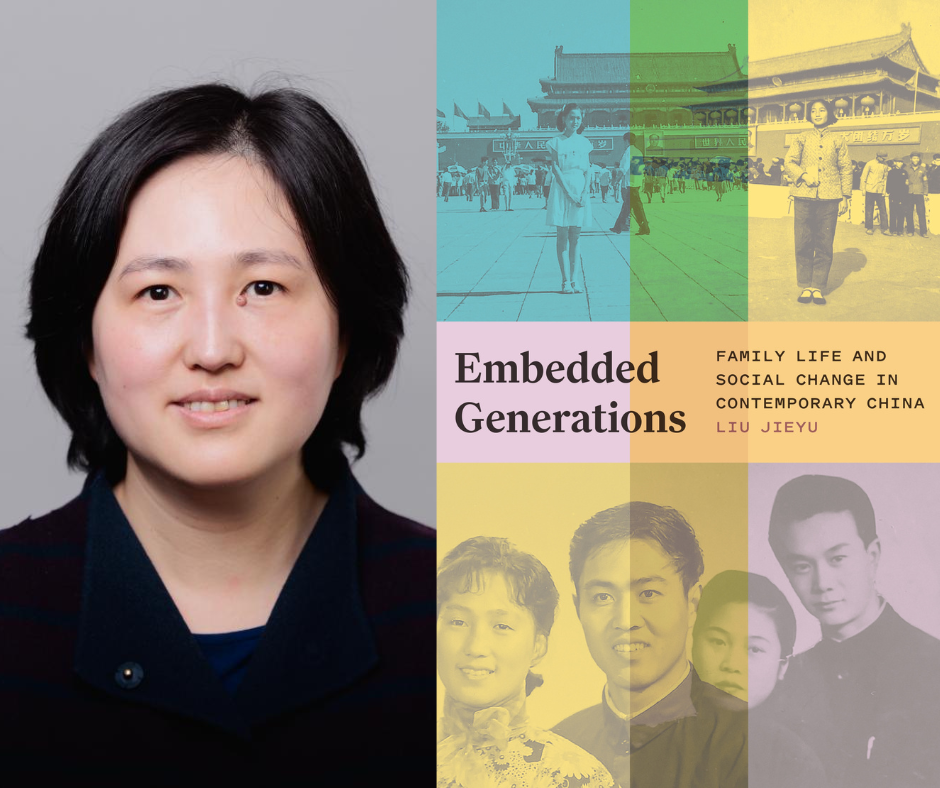
Professor Liu reveals a family portrait of complex change, continuity, and diversity. Rather than a straightforward transition from the traditional to the modern and postmodern, she argues, changes in Chinese family life have entailed the adaptation and “re-serving” of traditional ideas and practices to produce a bricolage of modern and traditional elements
The findings showed that sex remains a subject that is not openly spoken about – as even though the younger generation will engage more in pre-marital sex compared to the older generation, it is mostly with the person they will marry and the number of partners hasn’t necessarily increased. Except for a minority of women who openly embrace feminist principles to assert their sexual agency, the study shows gendered norm of sexuality persists - with the majority of women interviewed remaining considerably constrained both in their mindset and behaviour.
Marriage is also experienced as compulsory in life where many rate the relationship with their parents more highly compared with their spouse. Marriage is not necessarily perceived as a marriage between two people, but a unity of two families, where the relationship with the in-laws is deemed very important.
The study also examines the urban-rural divide showing that unlike other studies which predict a convergence in development between urban and rural regions, Professor Liu’s findings show persistent and even widening differences in the life journey between urban and rural families. For example, rural-urban segregation persists in finding a life partner or spouse across three generations of Chinese marriages.
Embedded Generations: Family Life and Social Change in Contemporary China, published by Princeton University Press, is available from 25 November 2025. The book launch will take place at SOAS on 23 February 2026.