A different way at looking at art history

Prajwal Trivedi speaks to Tanveer Atwal, a postgraduate Art History student, discussing a range of topics from colour palettes to art in the real world, wrong buses and the lessons you won’t see in a transcript.
Prajwal: Hi, Tanveer, thanks for agreeing to the interview. I always see you out and about on campus, so it’s nice to finally catch up! You’re doing a SOAS-Alphawood Postgraduate Diploma in Asian Art. Has studying it changed the way you see the subject? And has it changed the way you see SOAS?
Tanveer: Hi, glad we got around to doing this. Yes, definitely. It’s changed not just how I see art history or the art world, but how I see myself within it.
Usually, in Art History, you look at something, note the time, date, and place, and then move into analysis. But in this programme, it feels much more immersive.
We engage with objects in a comprehensive way - not just as artworks, but as things embedded in religion, politics, and culture.
It’s made me look at everyday objects differently, too. I don’t just see paintings as works of art anymore – I see ordinary things through that same lens. It blurs the boundaries between everyday life and academia, between discipline and lived experience.
Why SOAS?
Prajwal: When it comes to Art History, London has so many well-known art institutions. Did you choose SOAS deliberately over any of those? And what feels different about it?
Tanveer: I only applied to this programme, actually. I come from a liberal arts background – I majored in sociology – so I was looking for something interdisciplinary. The Asian Art programme here offered that.
In more conventional Art History departments, there’s often a heavy focus on theory. Theory is important, of course. But, here, there’s a strong object-based and experiential approach. We have museum visits almost weekly. We speak to curators and artists working in the field. Learning doesn’t end in the classroom.
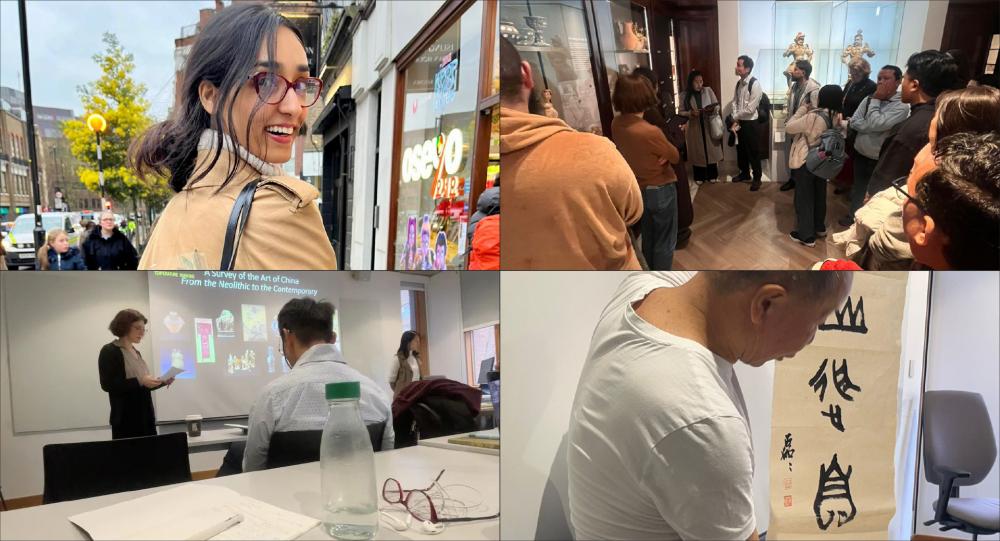
That mattered to me. Eventually, we’ll leave the classroom – we’ll live in the world. So, engaging with art in real spaces, not just in essays, feels essential. It’s helped me grow, and also unlearn certain limits of strictly classroom-based learning.
SOAS as an art movement
Prajwal: Keeping our artistic theme going, if SOAS were an artwork or an art movement, what do you think it would be?
Tanveer: That’s such a difficult question.
I don’t think I’d want to define it as one specific artwork or movement. The moment I do that, I’d be putting it in a box, and SOAS feels like it tries to resist that. It encourages us to look beyond frameworks, even though we are within an institution.
Maybe it’s something abstract. Something open-ended. I don’t think it wants to be contained.
Observer or participant?
Prajwal: You’re here for one academic year, and you’re one semester down. At this point, do you feel more like an observer or a participant?
Tanveer: At first, definitely an observer. Even though I was familiar with London, this was a new space for me.
In my first term, I mostly observed – how classes worked, how pedagogy functioned, how conversations unfolded. I think I was looking for other ways of thinking. Pure observation.
Now, I feel more like a participant. I’m more familiar with the rhythms of things. My classes are small – about 15 students – so it was intimidating at first. But now I feel more confident contributing to conversations. I wouldn’t say I’ve completely shifted, but I’m starting to participate more actively.
Highlights
Prajwal: What’s something about your time here you want to highlight that wouldn’t show up on a transcript?
Tanveer: A transcript only shows outcomes. A grade. A result. But there’s so much before that – the struggle, the discomfort, the process. I actually like being uncomfortable sometimes. Saying yes to things I wouldn’t usually do. Going to an art event, I wouldn’t have known about without a class. Trying to speak to someone new. Engaging with something unfamiliar. That growth, that internal process, would never show up on paper. Grades reflect a very small percentage of who we are.
SOAS as a colour palette
Prajwal: You’re studying Art History. If you had to give SOAS a colour palette what would it be?
Tanveer: Hah, okay, sure. I love warm, earthy tones. Greens especially. But maybe white – not plain, Pantone white. The kind of white you get when you spin a colour wheel and all the colours blur together. It looks white, but it contains everything. That feels more accurate.
Advice to future SOAS students
Prajwal: When you think about yourself here as a student at SOAS, is there any one piece of advice you’d like to give to SOAS students of the future?
Tanveer: Be present. It’s easy to focus on the next assignment, the next class, the future. But we forget to look at what’s happening right now.
In London, especially, everything moves quickly. So, try to pause, engage with things beyond academics. Just be here.
And maybe, get on the wrong bus sometimes. You never know. The wrong bus might be the right one for something else.
About the author
My name is Prajwal Trivedi, and I’m a final-year law student at SOAS. I’m deeply interested in how people experience institutions beyond what they’re meant to represent. I observe how students move through their university life, and how much of that life goes undocumented once people graduate and move on. I believe that the student experience is a very special time in life, and one that is worth recording with care.