Fantasy and reality in Edo Japan’s red-light district: Keisai Eisen’s Ukiyo-e woodblock prints

A closer look at three of Keisai Eisen's (1790-1848) mass-produced woodblock prints that aimed to show the glamour of Edo Japan’s red-light district and set fashion trends of the time.
Keisai Eisen was a painter, woodblock print designer and book illustrator. By the 1820s, he had established himself as a leading and prolific painter of bijinga or pictures of beautiful women. From 1818 to 1830, he produced large numbers of full-length portraits, many involving women of the Yoshiwara or pleasure quarters - a famous red-light district in Edo (present-day Tokyo).
A romanticised image of the floating world
Eisen’s vision of the Yoshiwara beauty exemplifies the standards of Edo style and fashion during the 1820s to 1830s, when ornate and elaborate deportment and dress were considered the ideal for most accomplished women or muses of the Yoshiwara.
Eisen’s prints bring to life the world of the ukiyo-e – the pictures of the floating world, a reference to the licensed brothels and theatre districts, inhabited by sex workers.
Eisen’s prints bring to life the world of the ukiyo-e – the pictures of the floating world, a reference to the licensed brothels and theatre districts, inhabited by sex workers and Kabuki actors in the cities of Japan during the Edo period (1615-1868). As style icons of their day, the fashions of these famous courtesans and actors filtered into society through these socially acceptable and conventional, widespread mass-produced woodblock prints.
Let's take a closer look
Within the SOAS Gallery collection, we have three prints by this “reckless bohemian”, as Eisen described himself in his autobiography Notes of a Nameless Old Man. In many respects, these are reminiscent of his A Tokaido Board Game of Courtesans (1821-23), in which he used landscape inserts to depict courtesans at the government post stations along the Tokaido road.
These images were produced to promote the world of the Yoshiwara, the red-light district.
Within these romanticised images of the floating world, the inserts guide the viewer to the courtesans and geisha within the sights of Edo’s most famous places. These images were produced to promote the world of the Yoshiwara, the red-light district.
The Peony of Tomigaoka, a Japanese courtesan
The image most likely depicts a high-ranking courtesan and reflects the ideal of female beauty defined in ukiyo-e prints: a small mouth, widely spaced eyes, and a straight nose. Her robes and accessories are elaborate and expensive. Tortoise-shell hairpins jut out on either side of her hairstyle; she also wears a large, wide sash, or obi, with a decorated design featuring butterflies and tortoises.
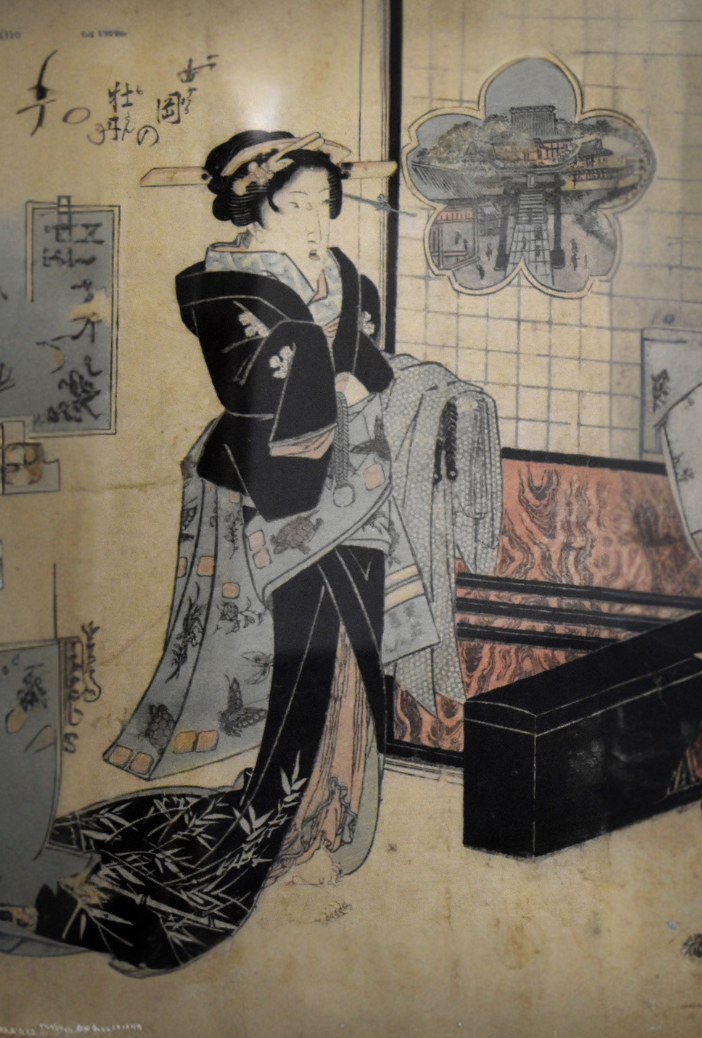
Her outermost garment, the uchikake, is expensive and elaborate, and features a woven design motif of bamboo at the hem, which was usually embroidered in gold or silver thread.
Her bare feet may suggest she is an oiran, a high-ranking courtesan, with her white powdered bare feet, poking out under her kimono, adding a flavour of eroticism. Her face is also painted white with oshiroi, a traditional foundation. Another ideal of beauty, such as blackening of the teeth, is also evident on closer inspection. We also see the black box, or fumibako, where love letters are kept.
These prints were mass-produced and sold cheaply, easily setting fashion trends, as a glamour exudes from the image.
Celebrated in ukiyo-e, or woodblock prints, these courtesans were the pin-up girls of their day. The depiction of the Tomigaoka Hachiman-gu shrine acts as a guide to the famous sites within Edo, of which this courtesan is clearly a part, and as the title itself evidently suggests.
Manpachiro, Ryogoku, Guide to Beauties and Restaurants
Ryogoku emerged as an entertainment district in the Edo period, with many fine dining restaurants, including Manpachiro. The beautiful young woman, most likely a geisha, wears an ornate outfit with an elaborately tied obi knot or musubi. Her kimono is adorned with turtles, a sign of longevity, good fortune, protection and wisdom, inviting good luck and blessings.
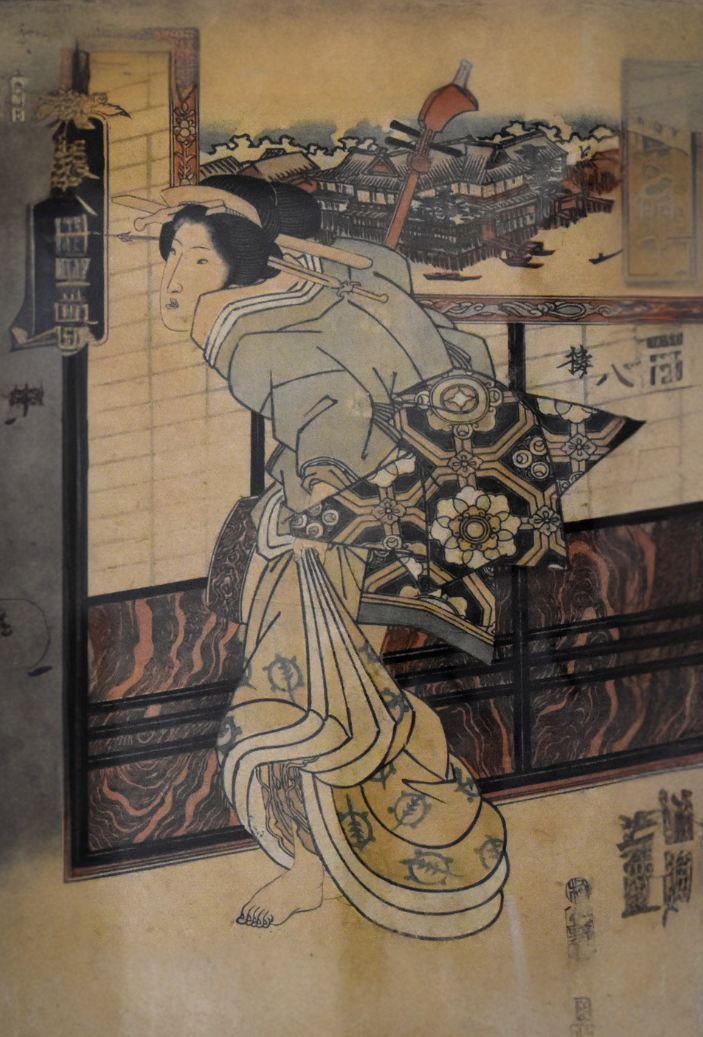
These prints were mass-produced and sold cheaply, easily setting fashion trends, as a glamour exudes from the image. The geisha gazes over her shoulder, inviting the viewer into the image. Her intricate hairstyle and combs display her fashionable status. She holds a shamisen, the iconic Japanese three-stringed instrument, which suggests the elegance of the entertainment that is offered.
Shadows on the Shoji: Beauty holding a letter
This print is from an untitled series featuring single figures of bijin in the foreground with poems and shadows on the shoji in the background. It depicts a beautiful courtesan wearing a blue-and-white lattice kimono, matched and tied with a striped obi, decorated with flowers on one side and pure black on the other.
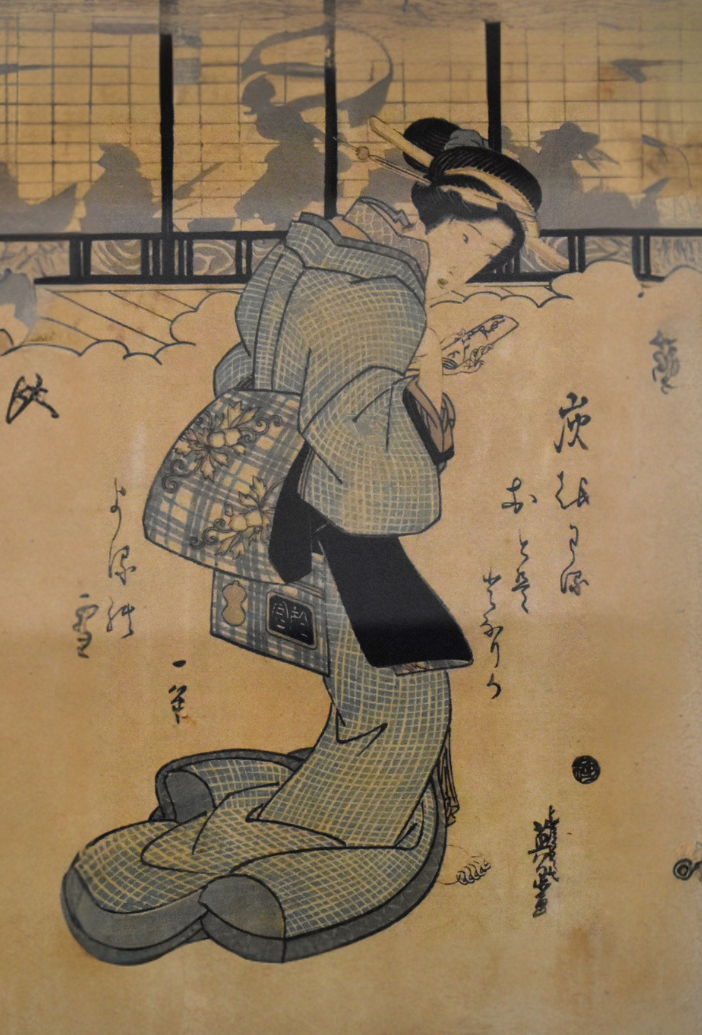
Two seals may be seen on the bottom edge of the obi, signifying good fortune. Her hair is pulled back into a sleek bun and adorned with metal and wooden hairpins. A poem is inscribed in the space around her. She looks at a letter in her hand, holding it close, contemplating the inscription and pausing as if she is conflicted about the contents. She is set against a stylised cloud, with shadows of figures, and lively festivities seen through the shoji panels.
The reality behind the images
These three images are beguiling and open the viewer up to the intriguing, complex and dark stories that bring to life the world inhabited by Keisai Eisen and the beautiful women he painted.
As captivating as these works are, let us not forget that the harsh reality for these women was very different, as they were sold into brothels from a very young age, abused, and held in debt, for which they could not escape.
The personal accounts of these women themselves do not exist; they are merely glamourised for the viewer through these prints.
Often from poor families, they were sold to brothels. No matter how successful they became, their debt became increasingly more difficult to work off. The more successful, the more lavish and elaborate their clothes, lodgings and attendants needed to be, with the debt increasing as this had to be paid for. The women also had daily targets to meet and would be punished or fined if they could not be met. Unwanted pregnancies and combating venereal disease were also part and parcel of their daily lives. There was no escape from this harsh living.
The personal accounts of these women themselves do not exist; they are merely glamourised for the viewer through these prints. However, their story is still paramount within these images of the floating world.
The three images will be on display in the Foyle Gallery at the SOAS Gallery from 15 January 2026. The Gallery is open from Tuesday to Saturday, 10.30am – 5pm, and on Thursdays the Gallery is open until 8pm. Admission is free.
About the author
Maria Rollo is the Collections & Engagement Officer at the SOAS Gallery.