How my internship at SOAS Gallery strengthened skills beyond curation

Through the Co-Creator Internship Programme, Xochitl Tai-Dawson gained hands-on experience in museum documentation and collections work at the SOAS Gallery.
Having the opportunity to be chosen as a member of the co-creator internship, specifically working on the museum documentation project, was one I will cherish and reflect back on for a lifetime. During my internship, I had the opportunity to work alongside the talented team at the SOAS Gallery, who taught me proper documentation and handling techniques.
I have gained tangible skills, the most important being the ability to conduct in-depth research, which is applicable to any field.
They taught me how to create museum-level condition reports as well as how to professionally interact with museum experts, allowing me to take away meaningful information from my interactions. While this internship is focused on museum curation, as someone who is studying a completely different subject and doesn’t want to go into the museum world, the internship within the gallery setting still benefited me greatly. I have gained tangible skills, the most important being the ability to conduct in-depth research, which is applicable to any field.
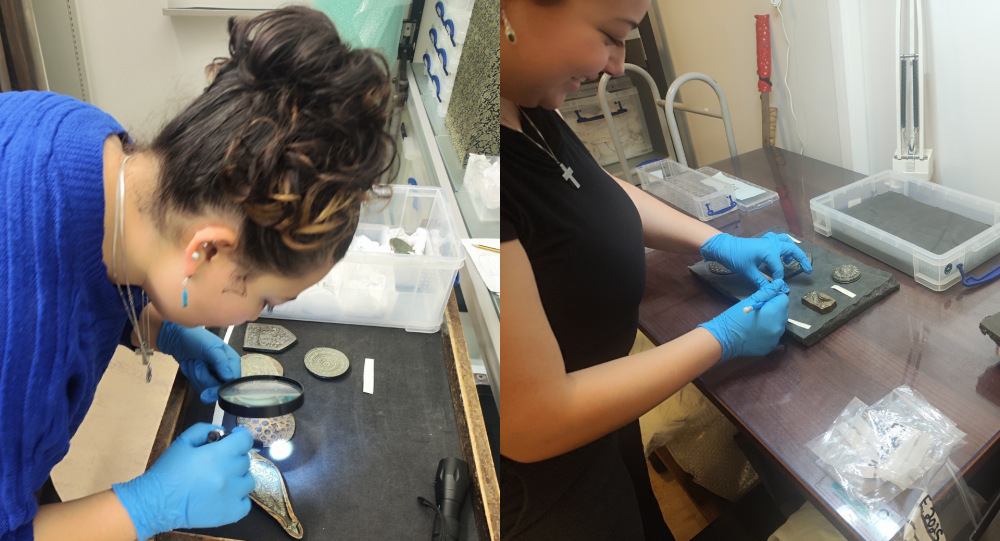
Over the past few months, my research focused on moulds used to mass-produce jewellery in India during the late nineteenth and early twentieth centuries, which broadened my understanding not only of Indian jewellery itself but also of its historical and artistic significance. These moulds were donated to the gallery and had no research or information done on them.
During my internship, I went down rabbit holes into auction sites and museum storerooms to learn about these seemingly unknown moulds. Through my research, I learned that these moulds were used to create jewellery through a technique known as Thappa, which is a traditional Indian technique where the moulds acted as a stamp to create an impression, essential for mass-producing uniform traditional jewellery. They likely originated in Rajasthan, originally used to create jewellery for royalty, then the technique migrated to Mumbai during the early 20th century, where they were used to mass-produce lightweight and cheaper pieces of gold jewellery.
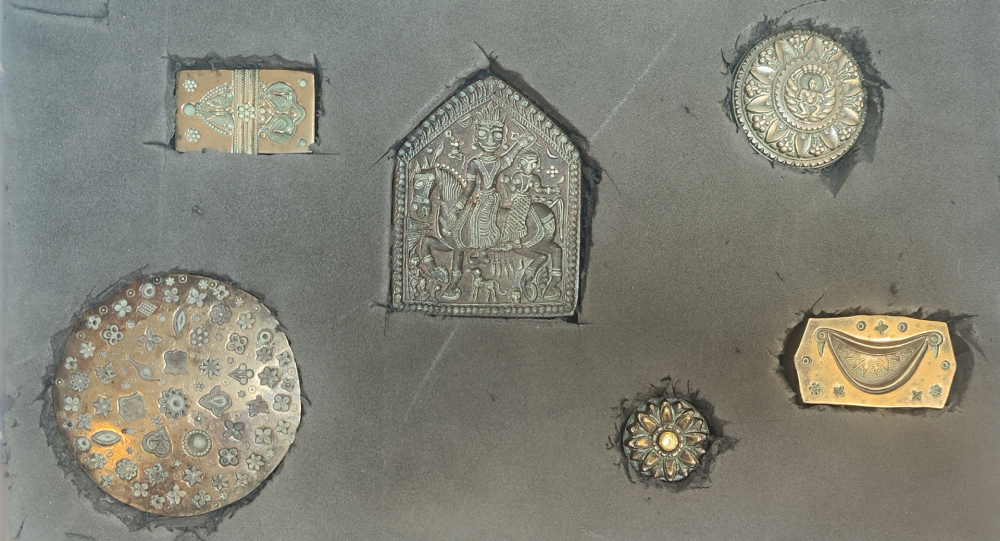
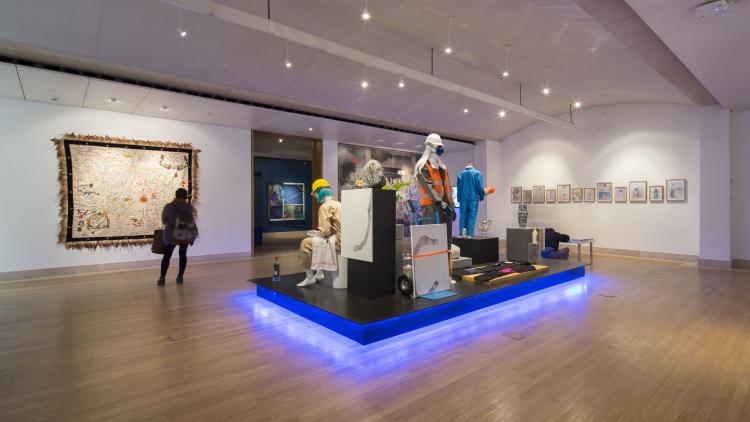
I went through the 95 moulds that were donated and picked five to put on display within the gallery's permanent gallery, as well as picked another six, which were used to create the gallery’s first-ever handling box, which is accompanied by an educational activity sheet that will help to guide anyone who uses the box in their teaching. Being hands-on with objects and seeing the craftsmanship that goes into creating each one has been especially meaningful during my internship, as they have opened my eyes to the time and dedication curators put into every item they research, as well as the intricacies of every object.
I am immensely grateful to have had the opportunity to do my internship at the SOAS Gallery.
I am immensely grateful to have had the opportunity to do my internship at the SOAS Gallery, not only are Lucy and John phenomenal advisors, who answered all my questions and encouraged my curiosity, but my understanding for museum curation which was limited at the beginning of my internship as grown immensely, growing my appreciation for galleries and the people that run them, as well as every object inside.
This internship, while labelled as curation-focused, allowed me, someone not remotely in the art world, an opportunity to explore my creative side as well as strengthen my research skills, and I encourage anyone to not only check out my section of the permanent exhibition but also to visit the SOAS Gallery to view the fascinating exhibits.
About the author
Xochitl Tai-Dawson is studying for a BA in International Relations and Global Development at SOAS University of London.