A placement working at the International Organization for Migration’s Displacement Tracking Matrix


MSc Global Development student, Madina Burkhanova, puts theory into practice during a work placement at the UN’s lead migration agency in London.
People are sometimes surprised to learn that the International Organization for Migration (IOM) has a London office, believing that its operations are concentrated in regions where fieldwork plays a more significant role but, as part of the International Development Placement module at SOAS, I received an offer to undertake an on-site placement at this office and, through this work experience, I became familiar with the London branch’s work in the context of the IOM’s global mission.
The Displacement Tracking Matrix (DTM)
The IOM is the United Nations’ lead migration agency 'dedicated to promoting humane and orderly migration'. It works through platforms that monitor, manage, and respond to crises, delivering humanitarian assistance for people on the move. One such platform is the Displacement Tracking Matrix (DTM). My placement situated me within the DTM team, an offshoot branch within the main London office.
The DTM was conceptualised in 2004, and it employs Mobility Tracking, Flow Monitoring, Registration, and Surveys to allow policymakers and humanitarian partners to better understand migration-related crises and maximise their responses. In short, it relies on masses of quantitative research, which is then synthesised into analytical reports to best assist in the dispersal of aid. The London office crucially helps analyse, consolidate, and edit all this raw data.
Theory into practice
For two months, my role as a team member entailed translating training modules for the DTM from English into French. In itself, this was enlightening, as I was able to enrich my professional French vocabulary and understand how students are trained to process critical data.
Additionally, I was also encouraged to undertake the training modules myself.
It was through this that I developed my proficiency in software such as Power BI and Excel. Though I had previous experience in these platforms, I had never explored them outside of academic contexts. Under the guidance of my supervisor, I acclimatised to IOM conventions of data analysis and integration. Suddenly, I found myself excited by the prospect of disaggregated charts and French jargon.
This overview of my role at the IOM might sound convoluted, but as many other Development Studies students will no doubt understand, there comes a point when you are afflicted by an impatience to start putting your education in practice. For me, that point became utterly consuming around Christmas-time.
SOAS has provided me with a topical, comprehensive skill-set for Development. It then went a step further and gave me a window into how I could empirically use my knowledge for global betterment. The multilingual, multidimensional nature of the work I did at the IOM then perfectly complemented my diverse classes.
For two days a week, I undertook my translation and data visualisation tasks alongside two other placement students and a team of diligent, articulate DTM associates.
I developed a strong understanding of the digital platforms and methodologies that lie at the core of effective responses to humanitarian issues across the world.
Furthermore, I was gratified to know that my work would be actively utilised: my translated training modules are due to be rolled out in seventeen West African countries.
Academically, I used my insights to write a final paper titled “Legibility and Technocratic Governance in the IOM’s Displacement Tracking Matrix”. This piece, beyond serving as a rounded conclusion to my placement, relied on an intimate understanding of the DTM and its intersection with various development theorists’ work; I am very proud of the resulting analysis.
A final message
If there is one distinct message to take away from this blog that goes beyond the specialised terms I’ve thrown around, it’s that what we learn as academics within Development is more crucial now than it ever has been. In a volatile and increasingly digitalised global landscape, the things we learn in our modules translate very transparently into the world around us. I knew this innately, but this placement cemented that knowledge.
I am grateful to SOAS, my professors, and the DTM team for allowing me the space to understand how intertwined and relevant our collective studies and efforts are.
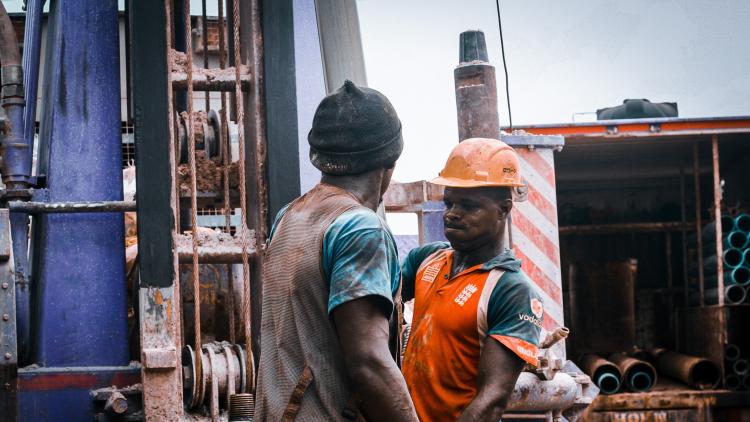
Image credit: Mostafa Meraji via Unsplash
About the author
Madina Burkhanova is an MSc Global Development student at SOAS.