The Ricardian Machine, (Alien) Life, and the Rift Between – Part 2


In Part 1 of this blogpost, I provided an introduction to Quentin’s framework in Part 1 of their book Capital, Revenue and the Non-equilibrium Thermodynamics of Value and explained their ontological characterisation of capital as a physical object, the Ricardian Machine (RM).
Through the application of process-ontology, this RM is designated as a physical system that uses itself up in order to make itself grow. Put differently, its characteristic process is one of self-consumption in service of self-growth. I explained that self-consumption is unequivocal and accentuated in Sraffa’s seminal text Production of Commodities by Means of Commodities (PCMC) and, by extension in the field of neo-Ricardian economics. Self-growth, however, required a further characterisation of the Ricardian Machine, not just as a physical thing but as a dissipative structure: a thermodynamically open system that maintains its organisation through the continuous transformation of energy which results in 1) the emergence of complex patterns and 2) the absence of static equilibria.
Given this characterisation, I presented Quentin’s quest for an adequate measure through which one can argue that the PCMC ensures that whatever existed previously, now exists in a greater quantity. I also explained why, on Quentin’s account, embodied labour and entropy are inadmissible: either for not being a physical but a social property of commodities or for not being additive throughout changes in commodities. This ultimately brought us to the introduction of thermodynamic depth defined as the difference between fine-grained and coarse-grained entropy, a seemingly difficult concept I tried to clarify by means of analogy: cleaning up your messy room. In Part 2 of this blogpost, my aim is to put thermodynamic depth to work: first by tracing it through the RM and Life as we know it, before arriving at what I find to be a refreshing conceptualization of the ecological rift.
Brick, wall, building: thermodynamic depth at work
So what does self-consumption in service of self-growth look like materially, once we leave your messy room move into the realm of economic processes that make up the RM? Stepping into the forest of oversimplification once more, let’s use clay as an example. In its raw state clay particles can be used as an input for the production of an endless number of commodities: pots, tiles, sculptures or a brick. This openness mirrors fine-grained entropy in your room before you start tidying up. No matter what clay is used for as an input, this fine-grained entropy neither grows nor shrinks. Instead, it stays constant just like all the potential micro-level configurations of the items contained in your room regardless of how you tidy up (or not).
But once labour is used to fire clay into a brick, a constraint is imposed on the clay which it didn’t have before: the clay must now take the form of a rigid, oblong and load-bearing physical object. This is a fresh layer of coarse-grained entropy or an informational constraint that’s been added to the macro-level state of clay particles. Coming back to your room, this resembles the growth in coarse-grained entropy as you engage in organisational steps that serve to tidy it up.
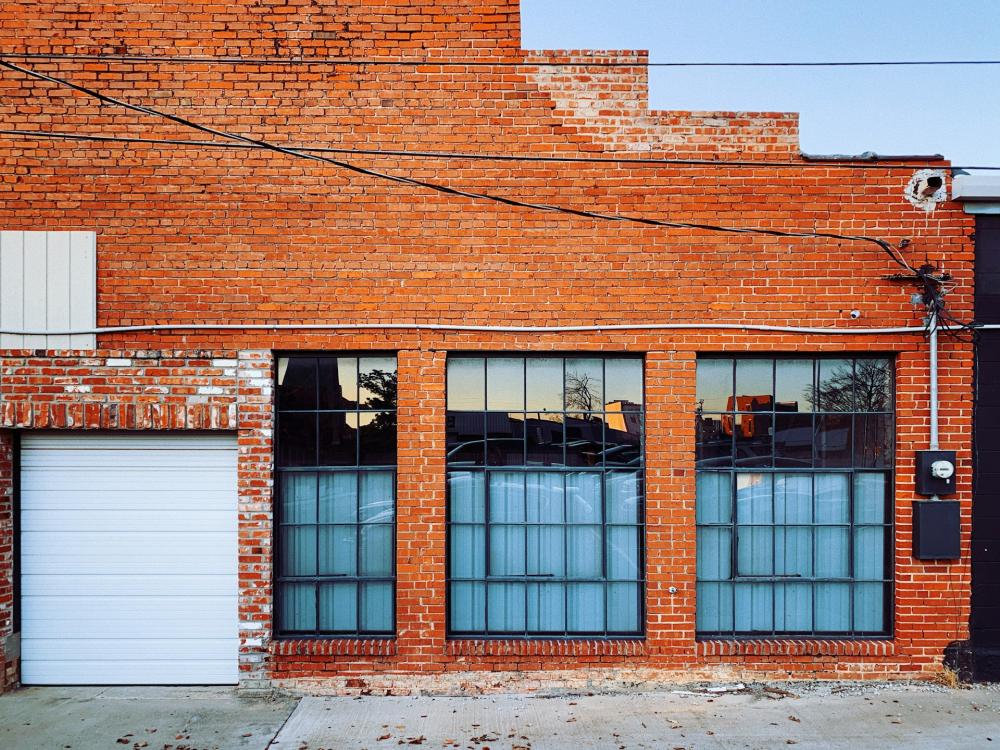
So while clay's fine-grained entropy stays constant, its coarse-grained entropy grows as it's processed into a brick. The widening gap between the two is precisely what thermodynamic depth measures but, this isn’t where its growth stops. Once the clay particles in a single brick are laid alongside other bricks and bound into a wall with mortar, another macro-level informational constraint appears on top of the previous one. The wall must now bear weight and resist collapse. As the wall becomes part of a building we’ll face yet another higher-order macro-level constraint related to the wall’s role in a specific physical structure.
To sum up, each stage the initial set of clay particles goes through – from clay mixture to brick, to wall, to building – results in an additional informational constraint which is added to the macro-level. This simple example goes to show why thermodynamic depth is the right measure of the RM’s self-consumption in service of self-growth. Every output the RM produces isn't simply more of what went in, the way "150 units of electricity" is more than "37.5 units of electricity" in Part 1's example. There’s an increase in a sharper but equally physical sense: every production process carries forward, and builds upon, the informational constraints that have been imposed at the different stages the necessary inputs underwent in the production of physical objects.
A tale of two dissipative structures “gone rogue”
The RM is not the only ensemble of physical objects Quentin treats as a dissipative structure whose characteristic process can be measured through thermodynamic depth. Life as we know it, taken in its entirety as a single continuous system stretching back roughly 3.5 billion years, also qualifies. What holds Life together as one continuous thing across that span, through mass extinctions, symbiosis, species splitting in two, is a concept Quentin borrows from process philosophy: genidentity. Simply put, a present state doesn't need to resemble an earlier one to count as continuous with it. Instead, it only needs to have its origin in it. The RM works the same way: whatever it is today, it got there through an unbroken chain of material production processes reaching back to whatever it was yesterday.
That parallel is important, but it isn't yet Quentin's central claim. Genidentity tells us Life and the RM are each unbroken from where they started but it doesn’t say anything about whether either still depends on the specific conditions that started them. That separate question is where Quentin's actual claim lies. Their claim isn't an analogy to evolution by natural selection either though. Quentin is explicit that the RM does not evolve the way organisms do, and that pointing out loose resemblances between firms going bust and species going extinct misses the point entirely. Instead, the claim relies on something Part 1's description of heated fluid already showed us: dissipative structures organise themselves around an energy gradient, a persistent difference in energy — like the heat below and the cooler fluid above — that the system feeds on in order to keep generating its convection cells.
Given the relationship between dissipative structures and energy gradients Quentin’s actual claim is that both Life and the RM, through their own distinct internal machinery, have broken free from the specific energy gradient that originally gave rise to them. Life no longer depends on the exact conditions that sparked it billions of years ago; the RM no longer depends on whatever specific resource first got it going. Both have become self-perpetuating, dragging their own energy gradients along with them rather than remaining tied to the one they started with. This is what Quentin means by dissipative structures "gone rogue." So unlike the heated fluid, which stops organising the moment the original heat source is removed, Life and the RM each generate, seek out, and switch between new energy gradients as circumstances demand. We can think of them as fires that have learned to relight themselves with different fuel.
Life no longer depends on the exact conditions that sparked it billions of years ago; the RM no longer depends on whatever specific resource first got it going. Both have become self-perpetuating, dragging their own energy gradients along with them rather than remaining tied to the one they started with.
Thermodynamic depth applied to Life as we know it
If depth is the right measure for the RM's self-consumption in service of self-growth, what does it actually mean when we apply it to Life as we know it?
Here Quentin draws on Stephen Jay Gould's Full House which argues that the popular idea that Life gets more complex over time is a statistical illusion. It’s true if we consider the mean complexity of organisms and because complexity has a floor (you can't get much simpler than a single-celled organism) but no ceiling. The far more meaningful measure according to Gould is the mode or the single most common type of organism at any point in time. And for Life as we know it, the mode is currently prokaryotic and has been so since the very beginning of the fossil record. In other words, Gould contests the idea that complex forms of life are where evolution was heading all along: they are just rare outliers dragging mean complexity upward.

Quentin goes on to explain that applying thermodynamic depth to Life as we know it results in tracking something more precise than either mean or mode complexity. It represents the cumulative number of genetic mutations locked into the genomes of every species alive today. Unlike ad hoc measures of "complexity," which struggle to account for organisms that become simpler over time (many parasites, for instance), thermodynamic depth is additive by nature meaning that nothing is lost, only ever added, exactly as with your room or the brick.
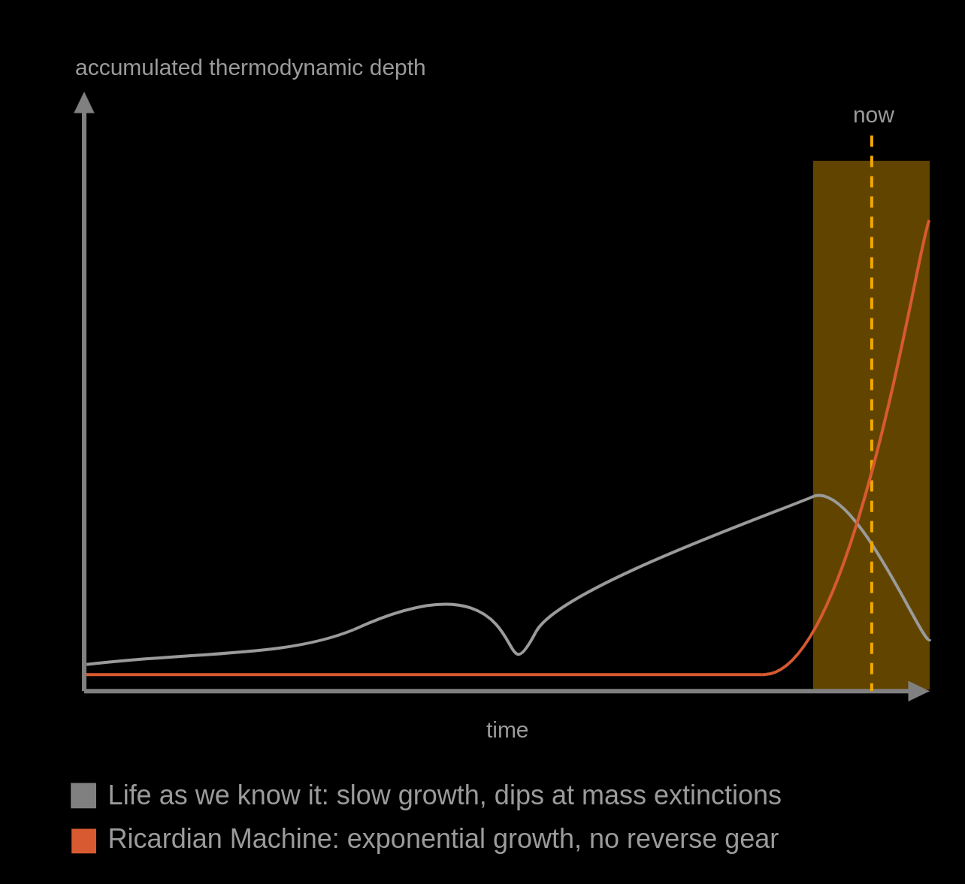
But here's where the RM and Life sharply diverge. Life's thermodynamic depth grows agonisingly slowly with some species remaining unchanged for hundreds of millions of years, and even "rapid" evolutionary shifts taking tens of thousands of years to unfold. More importantly, a mass extinction event where a swathe of species is wiped out at once would even cause the thermodynamic depth of Life as a whole to fall. The RM's depth, by contrast, grows exponentially and shows no comparable tendency to reverse. Life and the RM, then, are both dissipative structures that have broken free of their original energy gradient. But they've done so at wildly different speeds. That difference is where the concluding part of this story begins.
A new thermodynamic approach to the ecological rift
Quentin isn't suggesting yet another lens through which one can more accurately study the origins, manifestations and persistence of intertwined and multi-scalar socio-ecological crises. The relationship between production, accumulation, social relations and ecological disruptions is necessarily heterogenous in its manifestation and will require a plethora of lenses to develop novel insights and solutions. What matters is that this relationship exists and Quentin's contribution is a single, abstract, and physically grounded story that traces it through the material logic of the RM itself.
Quentin’s story comes down to a rift in thermodynamic depth, between Life and the RM. Life's depth creeps upward very slowly at a rate of about hundreds of millions of years per step and dips during mass extinction events. In contrast, the RM's depth has been accumulating exponentially for barely two hundred and fifty years, with no comparable capacity to reverse: global material extraction alone has more than tripled since 1970, regardless of wars, blockades, or supply shocks along the way. On top of this, we are currently living in a period where species are vanishing at roughly a hundred times the background rate, meaning that Life's depth is falling at precisely the moment the RM's is climbing ever-faster. Picture the two curves side by side: two dissipative structures, both "gone rogue" from their origins, now pulling apart.
I think it’s important to understand this doesn’t mean that capitalism is a biological inevitability. Quentin is careful in making clear that humans may well be predisposed, in some genetic sense, to make and use tools, even to trade. But nothing in our biology explains why the thermodynamic depth of what we produce should grow exponentially. This dynamic is uniquely capitalism's, a historically contingent social arrangement which one can certainly describe in thermodynamic language but is not predetermined by it. The Ricardian Machine is not a genetic destiny written into us; it is one specific, relatively recent way of organising production among others that were, and remain, possible.
But nothing in our biology explains why the thermodynamic depth of what we produce should grow exponentially. This dynamic is uniquely capitalism's, a historically contingent social arrangement which one can certainly describe in thermodynamic language but is not derived from biology.
This leaves us somewhere strange. The RM behaves like Life, shares its most fundamental thermodynamic signature, and yet answers to none of Life's constraints. The RM is, as Quentin puts it, “Life as we don’t know it” or an alien with its own xenobiology, unconstrained by any biological rules, metabolising our biosphere through a widening rift. Part 2 of Quentin's book turns to capital and revenue, a familiar terrain for political economy, denominated in cash rather than depth. But underneath this shift away from thermodynamics, the same alien RM is merely studied from a different angle: what looks like ordinary economics turns out to be xenobiology all along.
It is, as Quentin puts it, “Life as we don’t know it” or an alien with its own xenobiology, unconstrained by any biological rules, dropped into our biosphere and metabolising it through a widening rift.
Header image credit: Warren Umoh via Unsplash.