Studying MA Global Media at SOAS: Challenging Western hegemony in the digital age


After working in Washington, D.C., Houlton decided that they wanted to learn the mechanisms behind media power and how to empower new voices. So they chose to study an MA in Global Media and Digital Communications at SOAS.
I came to SOAS after six years in the belly of the beast, Washington, D.C., where I had a front row seat as the roaring engine of Western neoliberalism slowly imploded. My experiences there made one thing clear above all else: that revolutionary times require revolutionary thinking.
The challenges that continue to define the twenty-first century, whether the return of fascism or impending climate disaster, will not be beaten by stubbornly sticking to outdated ways of thought. It’s time to deconstruct what’s not working, empower new voices, and collaboratively forge new truths that can deliver us from the tragedies unfolding before us.
Whose logic are we listening to? What narratives do we passively accept?
Importantly, rising to this occasion is not just a matter of understanding and critiquing political power, capital, or social positionalities. It is about knowing how these forces intersect to produce what we believe are “reasonable” solutions and thus curb our horizon of possibilities. It is about accepting that, yes, knowledge is power, but that power produces knowledge to begin with. Whose logic are we listening to? What narratives do we passively accept? And how can we exploit their weaknesses and subvert their strengths? The future belongs to those of us who can tell the most convincing story, and I chose SOAS’s MA in Global Media and Digital Communications to help me learn how to do exactly that.
While in Washington…
I finished my undergraduate degree in 2022, having spent my time in university learning about postcolonial theory and interrogating Western hegemony. You can understand, then, why SOAS caught my eye. A place truly dedicated to critical theory, with a community of scholars and students focused on envisioning a more just world, seemed like the perfect environment for me. But I wanted to see and understand how Western hegemony operated firsthand, and through my work experience at a DC-based thinktank I started to grasp the crucial role of media and technology.
I didn’t want my job to be putting tape over the cracks—I wanted to help pick up the rubble and build something new, something better.
On the one hand, I got to witness and participate in the Internet’s unparalleled power to create solidarities across vast distances. It could support massive prodemocracy movements, diasporic news production, and transnational advocacy and education initiatives. On the other hand, I was forced to grapple with how the digital space fomented hatred, harassment, and misinformation. I saw how tech billionaires and aspiring autocrats leveraged new technologies to cement injustice and their selfish agendas.
Most importantly, though, I came face-to-face with my own role as a knowledge producer as I watched wars start and genocides unfold from behind my work computer screen. Whose messages did leadership allow me to amplify, and who was I forbidden from engaging with? Who was given the agency to share their perspectives, and whose were denied and delegitimised? Amid these crises, as the forces-that-be took a sledgehammer to the façade of a rules-based international order, I began to feel like a propagandist for a failing system. I didn’t want my job to be putting tape over the cracks—I wanted to help pick up the rubble and build something new, something better.
Living in London…
Moving to London to pursue the MA in Global Media and Digital Communications at SOAS was the best choice I could have possibly made amid such frustration. In a matter of weeks, I better understood not just the mechanisms of media power (ownership and algorithms, flows of culture and ideologies) but my own positionality within them. I was introduced to the ongoing debates around artificial intelligence, data extraction, and platform imperialism. And rather than just being taught how the systems of power dominate our lives in the twenty-first century, SOAS empowered me to brainstorm how to find these systems’ weaknesses, to highlight how people overcome or subvert these levers, and identify legitimate opportunities for progress, growth, and change.
In a matter of weeks, I better understood not just the mechanisms of media power (ownership and algorithms, flows of culture and ideologies) but my own positionality within them.
But most of all, if you can forgive the cliché, my favourite part of the media degree at SOAS so far has been the people I’ve met along the way. My new friends and peers, who have backgrounds in journalism, humanitarian aid, development, content creation, and much more, are among the smartest and most creative people I know. I enormously benefit from even the smallest, silliest conversations and am deeply thankful for their companionship and collaboration in and outside of class.
If you aren’t convinced to apply for a degree in media yet, let me end with this: if you want to understand power, take a politics course; But if you want to challenge it and change the narrative—consider communications.
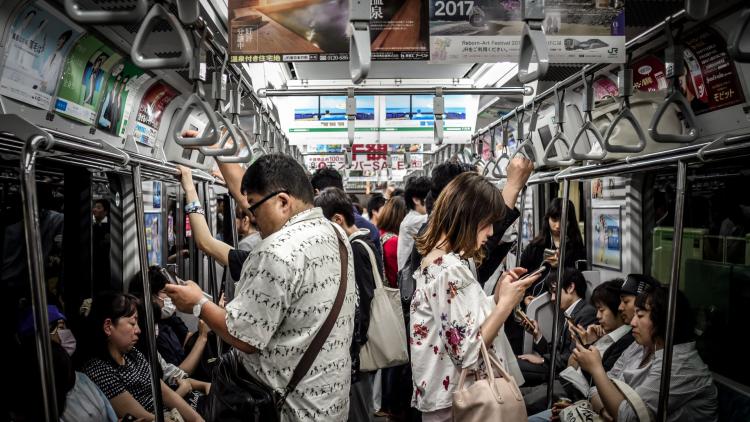
Header image credit: Camilo Jimenez via Unsplash
About the author
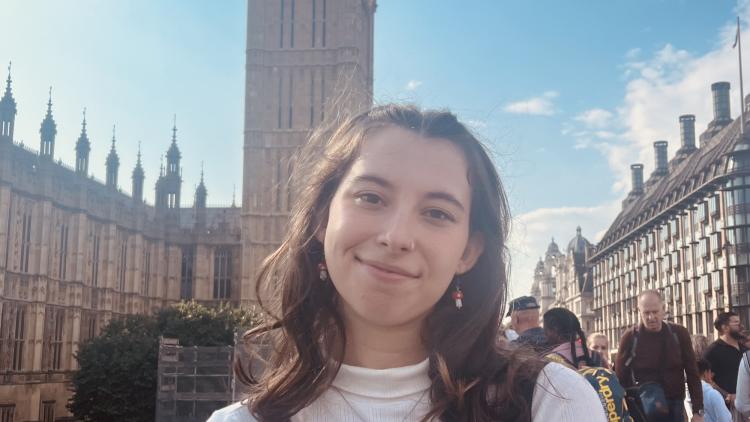
Houlton Dannenberg is pursuing an MA in Global Media and Digital Communications at SOAS. They have a background in democracy advocacy and digital strategy and are passionate about finding creative ways to uplift marginalized voices. Houlton has previously worked and lived in Washington, DC, Anchorage, Alaska, and Christchurch, New Zealand.