“Who Gets to Live in Paradise?”: The Caribbean and the Neo-Imperial Patterns of the Tourism Industry


When the development of Caribbean nations depends on the growth of the tourism industry, economic sovereignty is often the sacrifice. Here, Anthony Bourdain explores the consequences of this narrative.
In the 2014 Jamaica episode of Anthony Bourdain: Parts Unknown, Bourdain poses the central question of the episode: “Who gets to live in paradise?”.
Capturing the dual tension between the developers of the hotels that ultimately grow the national economy and the locals who lose their livelihoods in the process, Bourdain sets off to comprehend who are the villains and heroes of the story. After meeting with locals who fear displacement, locals who welcome tourism, and the millionaires in control of the expansion of tourism, Bourdain’s mission grows more and more complex. Yet a certainty remains, regardless of the moral and political positions of these actors, one side is in control while the other is placed in a position where it must adapt.
The Workings of the Caribbean Tourism Industry
The reality, as Bourdain explores, is that native Jamaicans are displaced from their land with promises of a growing economy, yet profits do not reach them.
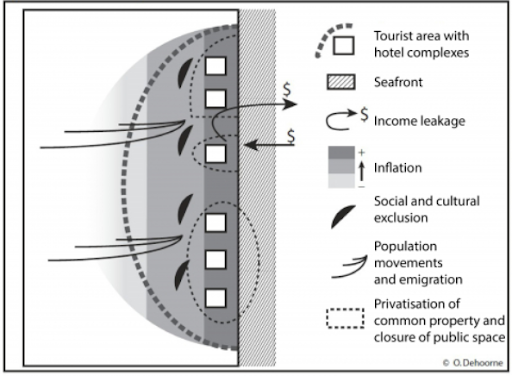
Tourism enterprises are owned by multinational corporations based in the Global North and they are heavily incentivised through tax-breaks and lower employment regulations to build their businesses in the Caribbean. With many small islands in competition for foreign investment, local wages, prices of supplies, and imposed taxes get suppressed in a ‘race to the bottom’, maximising the potential for economic leakages as multinational corporations offshore the untaxed profits.
Therefore, despite the accelerating levels of tourist arrivals, UN Tourism reports 80% of all tourist spending in the Caribbean to be exported to the Global North. These islands are continuously carved out for tourist enjoyment, casting out locals from common spaces that would allow them to continue their livelihood through jobs outside of the service industry.
As Dehoorne (2013) depicts in his diagram, the collateral damage from tourism falls disproportionately on the local population. The re-structuring of the local economy to be profitable for foreign tourism corporations over the domestic economy creates greater dependencies on an industry that is precarious and is inherently exploitative.
So why are the countries in the Caribbean still in the process of transitioning into becoming total service economies in the face of these drawbacks? The colonial history of these islands sheds much-needed light on this process. Efforts to specialise in various sectors through protecting their economies within these islands were either abandoned or overthrown due to US pressure to keep free-trade policies, leaving the service sector to be a last-resort venture for economic growth. With massive support from the Global North and the World Bank, these countries derisked foreign investments in the name of tourism through tax reliefs and import duty concessions for resorts and hotels.
Yet one of the biggest drawbacks of tourism as a means of economic growth is the active reliance on the underdevelopment of these nations, as the raw ‘beauty’ of an idyllic island is the very thing tourists pay for.
Therefore, tourism economies rely on preserving the unequal, colonial relations in which Caribbean nations remain sites of consumption rather than capital accumulation.
Tourism and Neo-Imperialism
In his seminal book, How Europe Underdeveloped Africa, Walter Rodney (1972) explains how economic development comes through the manipulation and extraction from nature. Therefore, one of the most defining components of the core-periphery relationship (or dependency theory) is to do with who profits from the land. As such, Britton (1982) demonstrates dependency within a tourism economy to be akin to a plantation economy, as both involve “the subordination of national economic autonomy to meet the interests of foreign pressure groups and privileged local classes rather than those development priorities arising from a broader political consensus (p. 334).”
With tourism being the biggest source of economic growth in the Caribbean, the overwhelming foreign ownership within the industry perpetuates class and regional inequalities, social tensions along with hindering ‘high value’ economic opportunities from the local population. Just as colonisers stunted and reduced local economies when operating large sugar plantations in Jamaica, the foreign-owned resorts and cruises likewise take away both land and jobs.
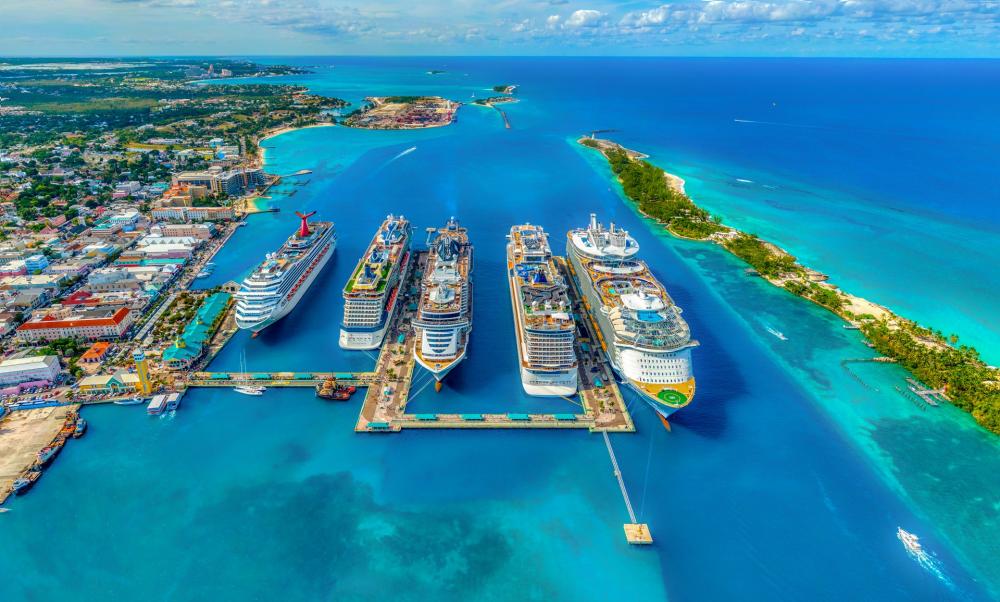
For this reason, ever so symbolically, the same ports built and used for transporting sugar in the 19th century Jamaica are today used by American and European cruise ships to continuously generate less and less revenue for the local economy through monopolising nearby businesses and attractions as well as generating excessive environmental waste. Here we can see how the growing levels of foreign ownership of the means of production perpetuate neo-imperial relations, where the exploited are economically dependent on the exploiters.
The imposed overreliance on foreign imports, businesses and tourists to operate the majority of the economy effectively deprive the Caribbean nations of the benefits of their own land and labour-force, resulting in exporting the gained surplus overseas.
Environmental Destruction
The toxicity of this dependency especially shows itself in the way the industry damages the environment, the very thing tourism relies on. In Jamaica, the relaxation of environmental regulations with aims of further attracting foreign investment have led to a rapid destruction of the country’s coral reefs and mangrove forests. This, then led to numerous attempts at saving the reefs and the beaches, notably by Chris Blackwell, a millionaire known for introducing Bob Marley to the world.
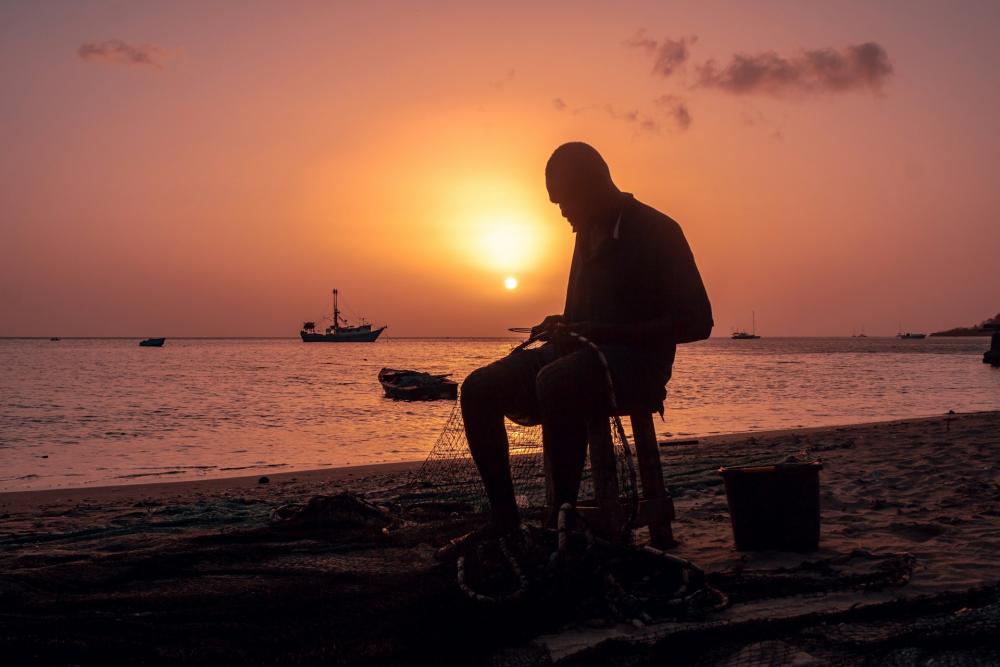
In his documentary, after being hosted by Blackwell and reflecting on the experiences of the locals, Bourdain poses the questions “Save the reef for who? Save the beach for whom?”. The restrictions of shallow water fishing in these beaches, noting that big fishing corporations have access to the ocean further along from the coastlines where they are damaging the environment even more, mean that local fishermen are the ones who get the short end of the stick. Therefore, locals are rightfully questioning why men like Chris Blackwell are saving the reefs and rebuilding the fish stock.
Although the formal end of colonisation resulted in significant political sovereignty gains for the Caribbean, it is the economic sovereignty that Bourdain questions. An analysis of the Caribbean tourism industry demonstrates how the development strategies promoted through global capitalism reproduce colonial core-periphery relations as growth remains dependent on external control and ownership of the economy.
While the tourism sector has contributed to the economic growth of these nations, the inevitability of Caribbean nations becoming a service economy continuously shifts the control of this growth on to wealthy, volatile tourists and their willingness to pay. Similarly, the profits from these tourists massively leak overseas, leaving the islands as colonial sites of extraction.
Through examining the tourism industry in Jamaica, Bourdain unearths the main question that reveals the imperial bias within the development: Who is it really for?
Gen-AI was not used for the creation of this content and the argument. Gen-AI was strictly used for preliminary research.
Header image credit: Tom Podmore via Unsplash.
About the author
Laura Kockara is MSc graduate at SOAS University of London, Department of Economics.