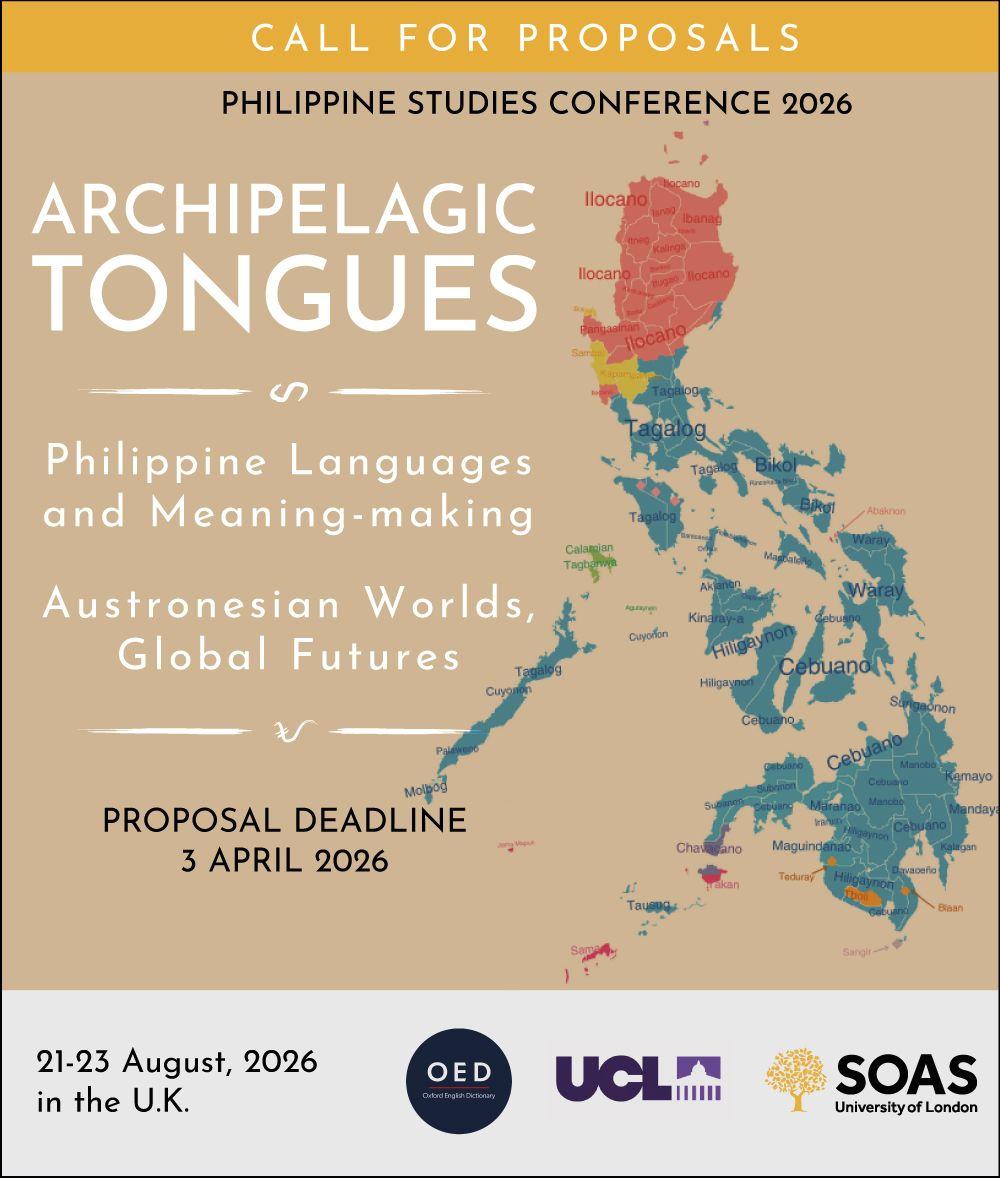
2026 Philippine Studies Conference: 'Archipelagic Tongues — Philippine Languages and Meaning-making, Austronesian Worlds and Global Futures'

Key information
- Date
- Time
-
9:30 am
- Venue
- SOAS University of London
- Room
- Khalili Lecture Theatre (KLT), Main Building
- Event type
- Conference
About this event
The 2026 Philippine Studies Conference in the UK will feature presentations that will engage with Philippine languages in their fullest sense: as systems of communication, sites of power, repositories of knowledge, and creative, political, and ethical practices.
Languages in the Philippines are deeply archipelagic — shaped by mobility, encounter, and world-making across land, sea, and time. These archipelagic formations are not only linguistic but semiotic, encompassing speech, writing, gesture, sound, image, material culture, and spatial practice. Circulating across an extraordinarily multilingual landscape, Philippine languages carry Austronesian worlds, colonial and postcolonial histories, and contemporary global circulations. They shape how people speak, translate, remember, resist, and imagine futures—within the Philippines and across diasporic, transnational, and digital spaces. These processes unfold not only through language, but through interwoven semiotic ecologies—of bodies and voices, scripts and screens, landscapes and architectures, ritual and performance.
We welcome contributions that explore Philippine languages in relation to Austronesian connections, colonial and postcolonial formations, World Englishes, Unequal Englishes, translanguaging, linguistic landscapes, translation, education, migration, and cultural production, as well as the semiotic forms and practices through which meanings are made, contested, and circulated—across visual, sonic, spatial, embodied, and material modes.
The three-day conference will feature plenary sessions and a wide range of panels, bringing together speakers to explore interdisciplinary, decolonial, and experimental approaches that engage non-textual, practice-based, or multimodal forms of inquiry and knowledge-making.
Themes we will explore
Austronesian Worlds and Archipelagic Connections
- Philippine languages within Austronesian language families and networks
- Linguistic mobility, seafaring, and archipelagic connectivity
- Comparative Austronesian linguistics and cultural resonances
- Orality, sound, rhythm, and poetics across Austronesian-speaking worlds
- Language, ecology, and island epistemologies
Colonial Languages and Postcolonial Conditions
- Colonial and postcolonial schooling and the marginalisation of non-spoken languages
- Spanish, English, and other colonial languages in the Philippines
- Language as a technology of empire, governance, and education
- Missionary linguistics, grammars, vocabularies, and early dictionaries
- Language standardisation, classification, and discipline
- Postcolonial critiques of linguistic hierarchy, authority, and legitimacy
- Colonial languages and the reproduction of social inequality
Englishes in the Philippines and Beyond
- Philippine English as a World English
- Accent, class, race, and linguistic capital
- English in schooling, labour, migration, and diasporic life
- English in global service economies (e.g. call centres, care work)
- Creative, vernacular, and resistant uses of English
- Writings in Philippine Englishes
- English as Medium of Instruction
Translation, Untranslatability, and Circulation
- Translation between Philippine languages
- Translating Philippine languages into Spanish, English, and other global languages
- Untranslatable terms, concepts, and affects
- Ethics, politics, and poetics of translation
- Translation as activism, repair, pedagogy, or refusal
Scripts, Texts, and Linguistic Archives
- Baybayin and other precolonial, colonial, and hybrid scripts
- Manuscripts, inscriptions, dictionaries, and pedagogical texts
- Linguistic archives as sites of power, loss, and recovery
- Digital humanities, documentation, and endangered languages
- Community-led, participatory, and reciprocal archiving practices
Language, Signs, Indigeneity, and Knowledge Systems
- Embodied, visual, and material signs in indigenous knowledge-making
- Epistemic violence against Indigenous semiotic systems
- Indigenous languages as knowledge systems
- Language, land, ritual, and cosmology
- Linguistic sovereignty and self-determination
- The politics of Filipino Sign Language
Community-based language work and intergenerational transmission
- Language, Identity, and Belonging
- Mother tongues, heritage languages, and multilingual lifeworlds
- Language, kinship, and everyday intimacy
- Code-switching, translanguaging, hybridity, and linguistic creativity
- Language, gender, sexuality, and embodiment
- Language, affect, and memory
- Language loss, shift, maintenance and revitalisation
Language in Performance, Sound, and Visual Culture
- Signed languages and visual performanceSpoken word, poetry, chant, and song
- Language in ritual, theatre, and performance art
- Soundscapes, radio, podcasts, and oral histories
- Film, subtitling, dubbing, and linguistic politics
- Visual, material, and spatial representations of language and script
- Pop songs and music videos
Language, Education, Policy, and Governance
- Inclusive and Exclusionary Policies and Practices Across Sensory Modalities
- Mother Tongue-Based Multilingual Education (MTB-MLE)
- Language policy, planning, and institutional practice
- Language in classrooms, communities, and informal learning spaces
- Teaching Philippine languages in the UK and globally
- Tensions between policy, practice, and lived linguistic realities
Language Futures: Digital, Diasporic, and Global
- Signed, Visual, and Other Non-oral Languages, technology and access
- Philippine languages in digital and online spaces
- Language and social media, AI, and emerging technologies
- Diasporic language practices and transnational circulation
- Youth language, slang, and linguistic innovation
- Imagining futures for Philippine languages
- Intercultural and cross-cultural exchanges
- Language as Method, Theory, and Refusal
- Language as epistemology and research method
- Naming, classification, and world-making
- Silence, opacity, and refusal as linguistic practices
- Linguistic approaches in history, anthropology, art history, and beyond
- Experimental, collaborative, and practice-based methodologies
- Theorizing language and culture from the Philippines
This year’s conference is being developed in collaboration with colleagues from the Oxford English Dictionary and the the UCL Department of Linguistics. These collaborations reflect a shared commitment to critical, historical, and global approaches to language, and support the conference’s focus on Philippine languages, Austronesian worlds, World Englishes, translation, and the circulation of words, meanings, and linguistic knowledge across time and space.
Registration
For those who wish to present papers, we are still accepting proposals until 3 April 2026.
For those who wish to attend the conference as guest participants, there are no registration fees. However, we kindly ask that you register.
For further inquiries, please contact philippinestudies@soas.ac.uk. We look forward to engaging in critical discussions on Philippine languages.
Contact
- Organiser: Philippine Studies at SOAS
- Contact: philippinestudies@soas.ac.uk
Image: Part of/ Mangyan Bamboo Collection from Mindoro, Library of Congress, Asian Division
Event Poster