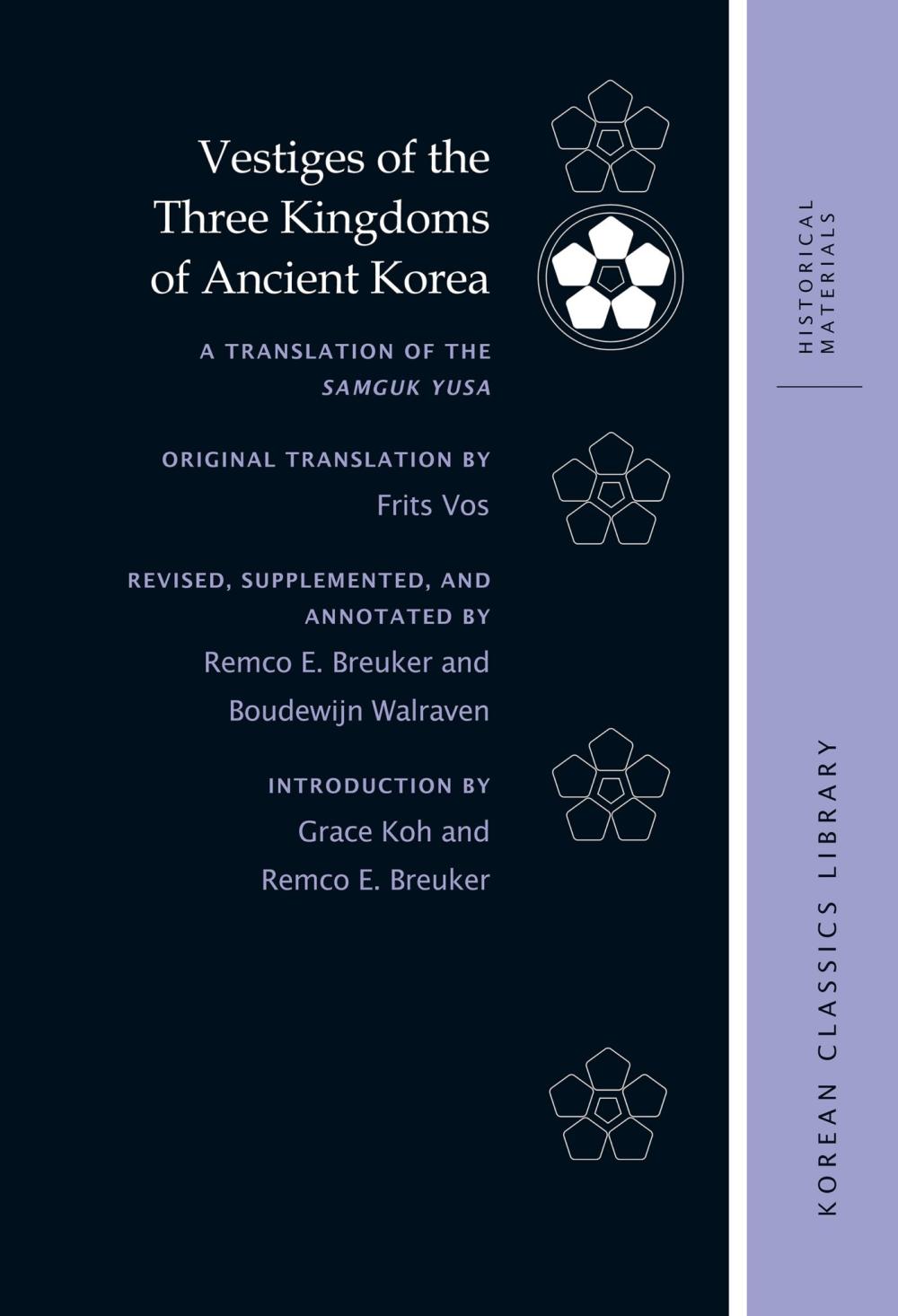
Book Launch - Vestiges of the Three Kingdoms of Ancient Korea: A Translation of the Samguk yusa

Key information
- Date
- Time
-
6:00 pm to 8:00 pm
- Venue
- Russell Square: College Buildings
- Room
- RG01
About this event
In this book launch event, Remco Breuker, Boudewijn Walraven and Grace Koh will introduce and discuss their recent publication, Vestiges of the Three Kingdoms of Ancient Korea: A Translation of the Samguk yusa.
Vestiges of the Three Kingdoms of Ancient Korea (Samguk yusa) is the first annotated English translation of one of the most important premodern Korean historical texts. One of only two surviving works on the Three Kingdoms period (57 BCE–668) and Greater Silla (668–936), the Samguk yusa is a rich collection of historical, supernatural, and mythical stories, including one of the earliest surviving narratives of Tan’gun, who in modern times came to be regarded as the mythical or legendary progenitor of the Korean people.
Compiled primarily in classical Chinese during the Koryŏ period (918–1392), the Samguk yusa is known for its idiosyncratic structure and eclectic content. Although strongly Buddhist in orientation and generally assumed to have been compiled in large part by the celebrated monk Iryŏn (1206–1289), the work also encompasses Confucianism, geomancy, secular history, and folklore. It was not highly regarded during the Chosŏn period (1392–1910) but re-emerged in the twentieth century as a Korean foundational text. Today the Samguk yusa is celebrated as a national treasure of native Korean tradition and heritage and continues to play a crucial role in forming Korean identity north and south of the border. References to it are commonplace in contemporary Korea, with new translations and adaptations of its narratives frequently published.
This annotated translation, the result of many years’ work by Frits Vos, a pioneer of Korean studies in Europe, and later colleagues, includes a critical introduction that illuminates the text’s history, reception, and broader historical context and offers an analytical overview of the themes and literary strategy of the work.
Registration
This event is free, open to the public, and held in person only.
Organiser
This event has been organised by the SOAS Centre of Korean Studies.
About the speakers
Remco Breuker is Professor of Korean Studies at Leiden University, the Netherlands. He majored in Japanese and Korean Studies at Leiden University and in Koryŏ history at Seoul National University. He has published extensively on Korean medieval history and contemporary North Korea. Among his publications are Forging the Truth: Creative Deception and National Identity in Medieval Korea (2009), Establishing a Pluralist Society in Medieval Korea (918-1170): History, Ideology and Identity in the Koryŏ Dynasty (2010), People for Profit: North Korean Forced Labour on a Global Scale (2018), Invented Traditions in North and South Korea (co-authored, 2022), and Not Everything Unfolds as Anticipated: An Annotated Translation of Selections from Yi Kyubo’s Tonguk Yi Sangguk chip (2025). He is editor of Korean Histories.
Boudewijn Walraven is Emeritus Professor of Korean Studies of Leiden University, his alma mater, and a former Distinguished Visiting Professor of Sungkyunkwan University in Seoul, who has served two terms as President of the Association for Korean Studies in Europe (AKSE). His research has focused on religious practices in past and present, with a particular interest in the relations between the various religious traditions co-existing in Korea, such as shamanism, Confucianism, and Buddhism. His publications have been based on a variety of sources, both oral and written (literary Sinitic (classical Chinese) and Korean), as well as on material culture and fieldwork. An interest in the anthropology of history led to his co-founding of the online journal Korean Histories, together with Remco Breuker and Koen De Ceuster.
Grace Koh is Lecturer in Korean Literature in the School of Languages, Cultures and Linguistics (SLCL) at SOAS. She has published and presented papers on the Samguk yusa which was the topic of her doctoral (DPhil) thesis at the University of Oxford. Since joining SOAS in 2002, she has taught modules on Korean and East Asian literature, literary theory, translation, culture and film, and has supervised MA and PhD students working on Korean and comparative literature and literary translation. She is currently working towards the completion of an edited volume on cross-cultural encounters and narratives in Korean and western travel literature from the 18th to early 20th centuries.