Dissent on the streets, in print, and through the lens: citizens and the state under authoritarianism

Key information
- Date
- Time
-
5:00 pm to 9:00 pm
- Venue
- SOAS Main Building
- Room
- DLT
- Event type
- Film screening
About this event
The Centre of Taiwan Studies is delighted to host a special screening of Eyes on Democracy and Behind the Scenes, exploring the roles of photojournalism, underground publications, and grassroots activism in challenging authoritarian rule and shaping Taiwan’s democratisation.
Commemorating the forthcoming 40th anniversary of the lifting of martial law in 1987, this transnational screening features two documentaries, Eyes on Democracy (民主之眼) and Behind the Scenes (幕後吶喊). Featuring nine veteran photojournalists, Eyes on Democracy presents Taiwan’s democratic awakening through the journalists’ lenses. It traces how their careers coincided with the emergence, expansion and diversification of socio-political movements since the early 1980s. Their decisions about where, when, what and how to capture the emotions and politics of either a large-scale rally or a localised sit-in have shaped how these movements are remembered and interpreted by later generations.
Focusing on 20 activists dedicated to protecting the public sphere, Behind the Scenes narrates the contribution of underground opposition magazines (黨外雜誌) to Taiwan’s democratisation. It zooms in on the activists’ strategies, collaborations and means of survival while they were under intensive surveillance by the authoritarian state. Their defiance of state censorship, which led to imprisonment and, at times, financial ruin, has left behind a powerful legacy concerning the transformative power of writing and reading.
At a time when artificial intelligence can generate images in a split second to accompany news stories that may themselves be produced by machines, the two documentaries also drive home a critical message about how ideas, concepts, cultures and practices travel across time, societies and geographical boundaries.
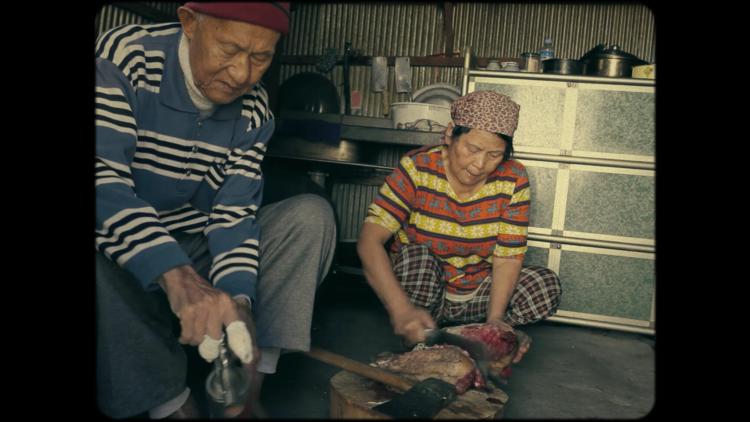
Image credit: still photo from Behind the Scenes
About the directors
Tzu-ming Huang is a veteran Taiwanese photojournalist, artist, and documentary filmmaker whose career spans more than four decades. Born in 1960, he graduated from the National Taiwan Academy of Arts in 1982 and went on to become Director of the Photo Desk at the China Times. His photographic work documented Taiwan’s social and political movements during the 1980s and 1990s, capturing pivotal moments in the island’s democratisation. Beyond political photojournalism, Huang is recognised for his humanist portrayals of marginalised communities, including former Chinese prisoners of war, Taiwanese comfort women, and Indigenous peoples. He has also contributed extensively to photographic education, archival preservation, and the development of photojournalism in Taiwan.
Yi-Chieh Chung is a Taiwanese photojournalist, documentary filmmaker, and researcher specialising in the history and sociology of photography. After beginning his career in newspaper photojournalism, he joined Reuters in 2002 and became chief photographer of its Taiwan bureau in 2005. A co-founder of the Taiwan Press Photographers Association (TPPA), Chung has dedicated much of his career to documenting and preserving Taiwan’s photographic history. His works include Dance with Images, a documentary examining Taiwanese photojournalism after the Second World War, and Eyes on Democracy, which brings together nine veteran photojournalists to revisit Taiwan’s transition from authoritarian rule to democracy.
Isabelle Cockel is Associate Professor in East Asian and Development Studies at the University of Portsmouth. Her research examines labour and marriage migration, state immigration policies, sovereignty, citizenship, motherhood, activism, and irregular farm work in East Asia. She uses public engagement, including academic blogs and film screenings, to highlight inequalities in migration. Her historical research explores Cold War psychological warfare and clandestine press in East Asia, examining how women’s voices served propaganda campaigns across the Taiwan Strait. She also develops the concept of 'dissent assemblage' to analyse how clandestine publications create public spheres for ideological exchange. She is Associate Editor of Political Studies Review and serves on the Editorial Board of the International Journal of Taiwan Studies.