New evidence on faith-sensitive domestic violence interventions emerges from SOAS research


A new SOAS-led study has contributed to a growing pool of evidence that calls for decolonial, faith-and culture-sensitive responses to domestic violence that are co-created with indigenous institutions in religious communities.
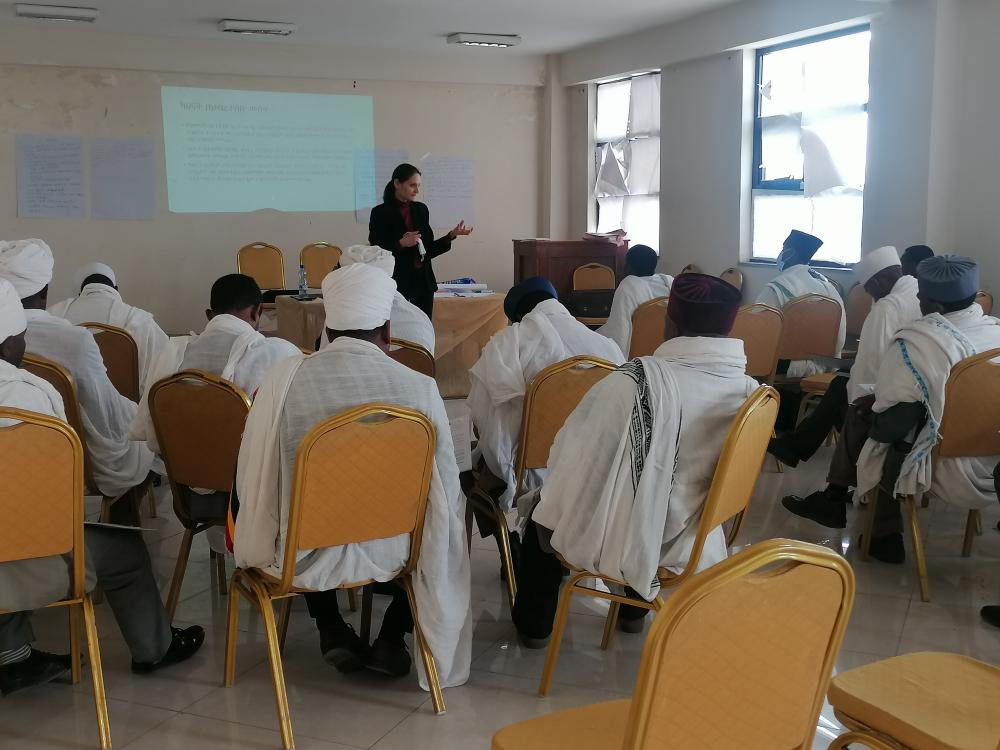
The study, published in the journal Religion and Development (Brill), uses a novel training approach that incorporates anthropological and theological knowledge to train Ethiopian Orthodox clergy on domestic violence.
The training’s evaluation showed that a faith-sensitive approach grounded in the theological traditions and everyday realities of clergy, where the training is delivered by trusted trainers, may be perceived as more credible in religious contexts.
Led by Dr Romina Istratii and co-delivered with the Ethiopian Orthodox Tewahedo and Inter-Church Aid Commission (EOTC DICAC) in Ethiopia, the pilot reached 155 clergy of the Ethiopian Orthodox Church between 2021 and 2022.
The pilot was designed in a culturally sensitive manner on the basis of long-term anthropological research in Ethiopian Orthodox communities and trust-based collaboration with Church-affiliated institutions and partners. It included carefully crafted anthropological, theological, legal, safeguarding and psychological training components.
Our study found that often priests were called to mediate conflict in the marriage, and in this context, they even confronted perpetrators.
The workshops were delivered in Amharic by Dr Istratii and two independent Ethiopian trainers, Mr Henok Hailu, a trained psychologist with an Ethiopian Orthodox theological training background, and Ms Bezaweet Birhanu, a legal expert affiliated with Ethiopian Women Lawyers’ Association (EWLA).
Similar to other societies, 34% of ever-married women in Ethiopia aged between the ages of 15 and 49 have reported having experienced physical, emotional or sexual violence from their husband or partner. Dr Istratii’s research on domestic violence in Ethiopia found that Orthodox women affected by domestic violence did not seek help for numerous reasons, including feeling shame and fearing the risk of divorce. Women often coped by relying on their faith and by seeking mediation through their spiritual fathers and cultural elders.
Dr Istratii said: “Our study found that often priests were called to mediate conflict in the marriage, and in this context, they even confronted perpetrators. Religious teachers and clerics were often inadequately equipped to support victims and survivors safely as they lacked both sufficient theological and safeguarding training on domestic violence.
“Our work with clergy starts from the recognition that many existing interventions that respond to domestic violence are built around western frameworks and understandings on gender-based violence theory and replicate biases that see ‘religion’ as only part of the problem and not for its potential resourcefulness.
“We aim to nuance these approaches by decoupling cultural norms and standards, often perceived or presented as part of people’s religious traditions, from authoritative theological teaching, and by using the latter resourcefully to build clergy-led responses.”
The evaluation data from the pilot has also shown that the theological approach provided the training with credibility from the perspective of the participants. Crucially, it also helped to build trust and enabled participants to become more confident in teaching against domestic violence in their communities. Participants also appeared to gain more confidence, particularly when supported over a longer period of time and when they were encouraged to take part in difficult conversations in a culturally appropriate manner.
This work is part of Project dldl/ድልድል, a research and innovation project funded by UK Research and Innovation, which aims to promote integrated and decolonial responses to domestic violence internationally.
Dr Romina Istratii currently directs the Institute of Domestic Violence, Religion & Migration, which continues this work with renewed UKRI FLF funding.