Professor Volz Delivers Keynote Speech at the World Bank’s 8th Global Policy Forum on Natural Capital


Professor Volz urges governments to integrate natural capital into financial and macroeconomic decision-making.
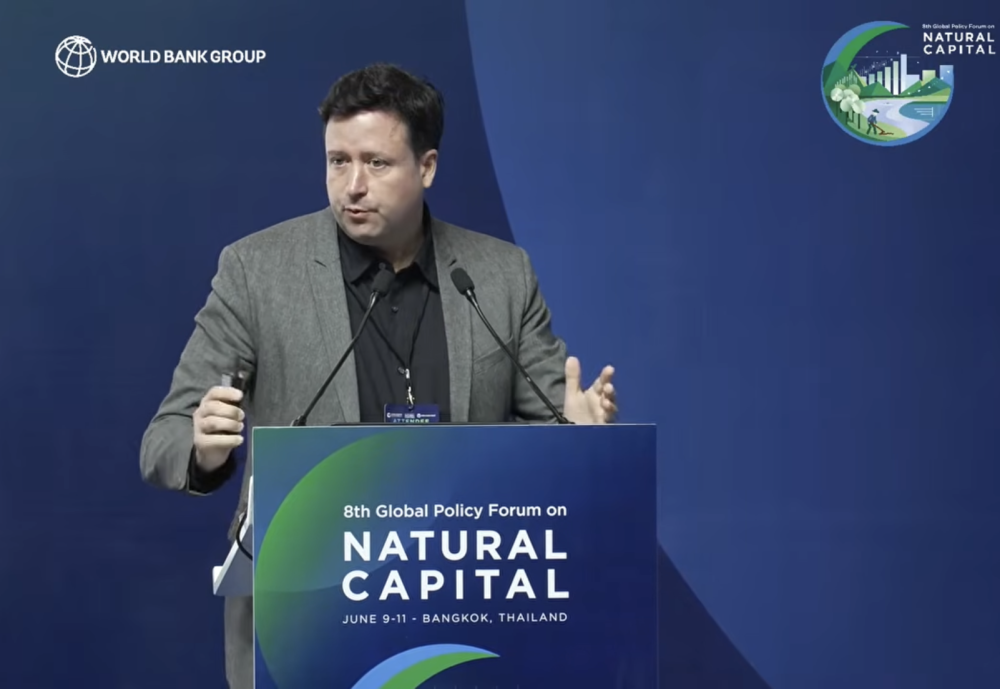
Professor Ulrich Volz was invited by the World Bank to deliver a keynote speech at the 8th Global Policy Forum on Natural Capital which took place in Bangkok from 9-10 June 2026. The forum’s theme this year was “From Insight to Impact: Making Natural Capital Matter for Policy, Finance, and Innovation”, focusing on the role of public policymakers – including finance ministries – in addressing and mitigating nature risks.
In his keynote speech on “Integrating Natural Capital into Financial and Macroeconomic Decision-Making: From Measurement to Market Transformation”, Professor Volz presented empirical evidence how nature loss is affecting public finances and put forward a three-pronged approach for supporting nature-positive development. This includes (i) using fiscal policy to set nature-positive incentives, (ii) developing prudential regulation and risk management to mitigate nature risks for the financial system, and (iii) developing capital allocation frameworks and market infrastructure to boost nature-positive investment.
He highlighted that finance ministries hold the levers for structural economic change through taxation, subsidies, and public spending. To shift private capital, finance ministries must rewrite economic incentives, including subsidy reform that reallocates the billions spent annually on environmentally harmful subsidies (such as agriculture, fossil fuels, and fisheries) into “nature-positive” incentives. They should also implement ecological tax reforms with taxes on resource depletion or biodiversity loss (e.g., pesticide taxes, land-conversion fees) to ensure negative externalities are priced in. Lastly, finance ministries should issue sovereign green, blue, and sustainability-linked bonds to fund national restoration efforts and set a benchmark for the private sector.
The SOAS Centre for Sustainable Finance has been at the forefront of research on the nexus between nature risk and sovereign debt. In 2022, Senior Fellow Dr Moritz Kraemer and Professor Ulrich Volz published the first debt sustainability analysis accounting for nature risks. Their simulations showed that a partial collapse of biodiversity and ecosystem services can have a substantial impact on debt sustainability metrics. Also in 2022, Kraemer and Volz published a study with other co-authors simulating the impact of nature loss on sovereign credit ratings. A follow up study, entitled “Biodiversity loss will decrease the future creditworthiness of nations”, was recently published in Nature Ecology & Evolution, a leading science journal.
Header image credit: Andreas Brücker via Unsplash.