SOAS Centre for Sustainable Finance Delivers Capacity Building Course for Caribbean Finance Ministries in collaboration with the Inter-American Development Bank and the University of the West Indies


The Resilience and Adaptation Mainstreaming Program (RAMP) University Network convened its second practitioner training course on the economics and finance of climate change adaptation in the Caribbean in collaboration with the Inter-American Development Bank and the University of the West Indies’ Fiscal Research Centre.
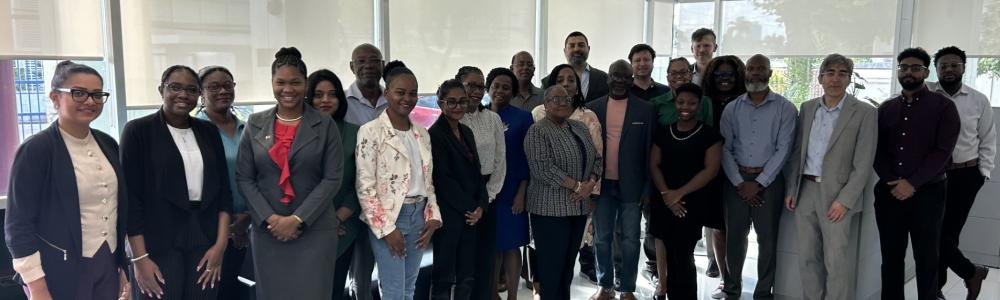
Port of Spain, 27 March 2026 – Held in Port of Spain, Trinidad & Tobago from 23-27 March, the course brought together a group of 30 participants from finance ministries and other ministries and government agencies for five days of intensive learning and exchange on a broad range of topics, including issues such as the macrocriticality of climate change and the fiscal risks facing Trinidad & Tobago and the wider Caribbean region, macro modelling and data challenges, climate-sensitive budgeting and budget tagging, and public and private adaptation finance.
Designed for officials from ministries of finance, ministries of planning and other public authorities in the Caribbean, the course was jointly convened by the SOAS Centre for Sustainable Finance, the Inter-American Development Bank (IDB) and the Fiscal Research Centre at the University of the West Indies (UWI). It combined conceptual discussions with case-based illustrations and group exercises, emphasising active learning and regional applicability.
This is the second capacity building of its kind in the Caribbean, following on from the first foundations course on the economics and finance of climate change adaptation delivered to public officials in Kingston, Jamaica in September 2025. The SOAS Centre for Sustainable Finance has previously delivered similar courses for finance ministries in Africa, including in Ethiopia, Kenya, Rwanda, and Uganda, involving local faculty from the RAMP University Network.
Led by Professor Ulrich Volz and Dr Harald Heubaum and with contributions from faculty at the University of the West Indies, participants explored the dimensions in which climate change can affect macro-fiscal dynamics, both as future risks emerge and as economies adapt to decarbonisation. Building on a discussion of the transmission channels through which climate change can affect public finances and sovereign risk, the course discussed potential threats, mitigation strategies, and opportunities for Caribbean economies.
The course also examined practical approaches to mainstreaming adaptation into economic appraisal, national investment planning and budgetary processes, and assessed sources and instruments for financing climate adaptation, including international climate funds, national public budgets, the Trinidad Green Fund, the potential for a green development bank, the use of debt instruments such as resilience bonds, as well as creating conditions to unlock private finance.
Professor Ulrich Volz, Academic Director of the RAMP University Network, pointed to the strong interest in RAMP and its topics in Trinidad & Tobago and beyond: “Caribbean economies are routinely affected by a range of climate-exacerbated natural hazards, including flooding and coastal erosion in Trinidad & Tobago. The strong interest in our training shows that government officials recognise that resilience isn’t optional but fundamental to fiscal stability and sustainable growth.”
Dr Harald Heubaum, Deputy Academic Director of the RAMP University Network, emphasised: “This course has built on the strengths of our first course in the Caribbean last year and, importantly, has brought in colleagues from UWI to co-teach materials. We look forward to continuing and expanding our collaboration with UWI and the IDB and deliver further courses for finance ministries in the Caribbean.”
The RAMP University Network is a key part of the Resilience Adaptation Mainstreaming Program (RAMP), hosted by the SOAS Centre for Sustainable Finance. The objective of RAMP is to accelerate climate adaptation in developing countries by building capacity in ministries of finance, planning and economics, to understand, plan for, and finance climate adaptation actions.
Header image credit: Renaldo Matamoro via Unsplash.