SOAS Centre for Sustainable Finance hosts events at the United Nations’ Fourth International Conference on Financing for Development


The SOAS Centre for Sustainable Finance co-organised three high-level side events at the United Nations’ Fourth International Conference on Financing for Development (FfD4) which took place in Seville from 30 June to 3 July 2025.
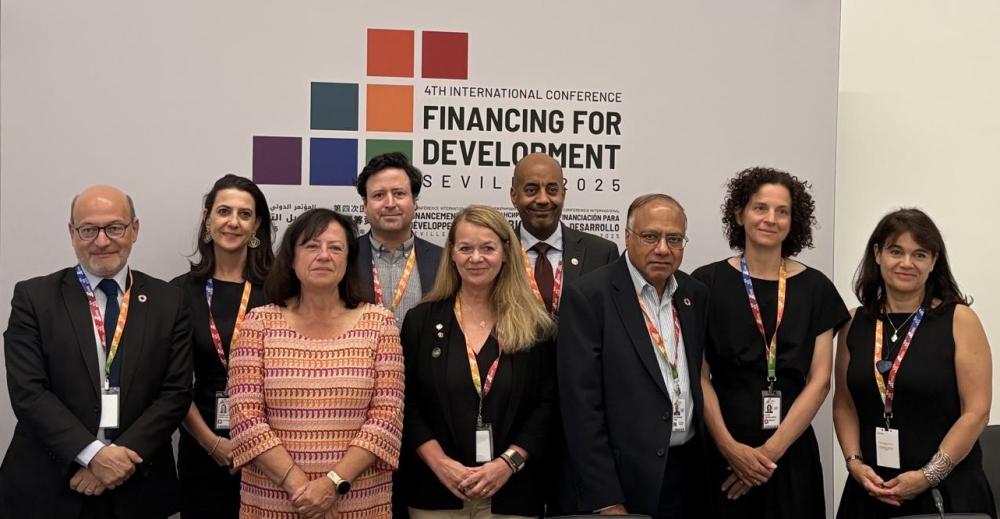
The first event, which was jointly organised with the German Federal Ministry for Economic Cooperation and Development (BMZ), was entitled “Accelerating the Shift – From Dialogue to Action: Empowering Public Development Banks in Emerging and Developing Economies to Drive Domestic Financial Resource Mobilisation and Private Climate Investment at Scale”.
The event focused on the critical role that public development banks in EMDEs – including national development banks and Southern-led regional PDBs – can assume in mobilising local savings and channelling them into local, sustainable investment. Mobilising domestic financial resources and developing local financial systems that finance productive investment is key to development. In her keynote address, BMZ State SecretaryBärbel Kofler underscored the importance of this agenda and highlighted the need to enable national development banks and Southern-led regional PDBs, building on successful examples.
The keynote was followed by contributions from Rémy Rioux, CEO ofAgence Française de Développement and Chairman of Finance in Common;Admassu Tadesse, President and CEO of the Trade and Development Bank Group; María José Naranjo Szauer, Vice President Corporate Strategy ofBancoldex; Andrea Hauser, Member of the Management Committee of KfW; Julia Nielson, Acting Director for Development Co-operation at the OECD; Amar Bhattacharya, Senior Fellow at the Brookings Institution; and Professor Ulrich Volz, the Director of the SOAS Centre for Sustainable Finance.
The discussion was moderated by Professor Barbara Buchner, Global Managing Director of the Climate Policy Initiative and Professor in Practice at the SOAS Centre for Sustainable Finance. The event was the culmination of a series of acceleration dialogues that the SOAS Centre for Sustainable Finance and the BMZ organised over the last 12 months withDevelopment Bank of Rwanda, Morocco’s Caisse de Dépôt et de Gestion, Colombia’s Bancoldex, KfW, the International Development Finance Club and the Financing for Sustainable Development Office at the United Nations Department of Economic and Social Affairs as part of Professor Ulrich Volz’s work as a member of the High-Level Friends Group Private Climate Finance for Development convened by the BMZ.
The Acceleration Dialogues were based on research conducted in a project on “Scaling up green investment in the Global South: Strengthening domestic financial resource mobilisation and attracting patient international capital” and the resulting policy recommendations that were put forward in a report on this topic.
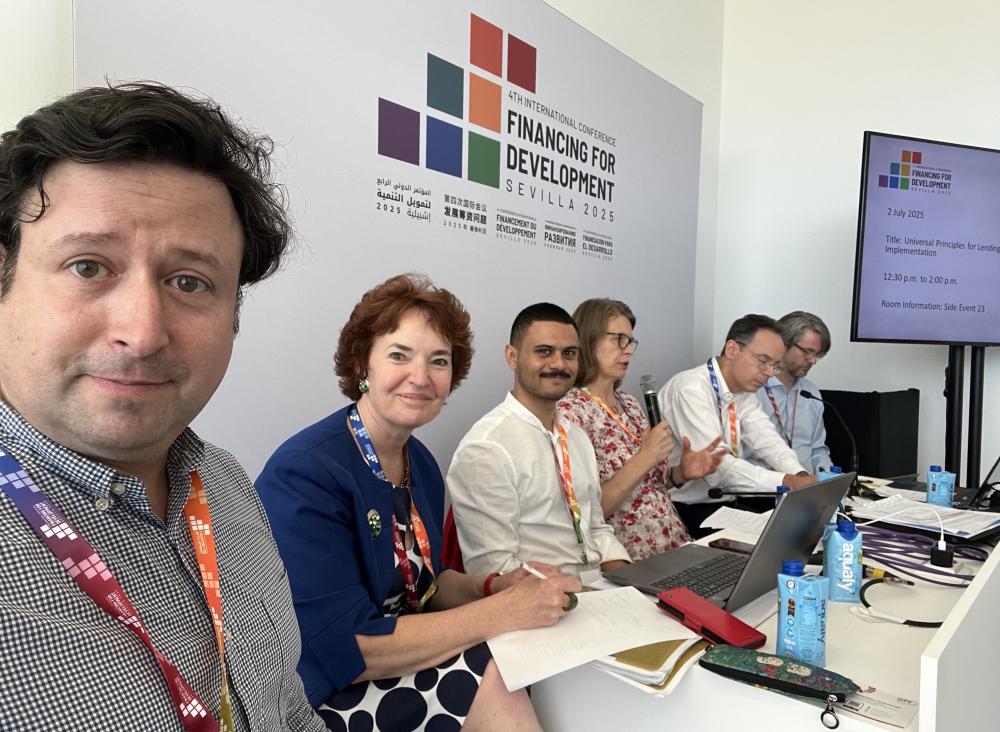
A second FfD4 side event that focused on “Universal Principles for Lending and Borrowing: Design and Road for Implementation” was jointly organised with the German Institute of Development and Sustainability (IDOS), the Institute for Economic Justice South Africa, the Global Solutions Initiative, the Global Policy Forum Europe, and Germanwatch. In the FfD4 final outcome document, the first point to address public debt accumulation and rising vulnerabilities is the principle of responsible sovereign borrowing and lending. These are usually defined as a set of non-legislative rules applicable to all market participants, could play a key role in preventing and resolving debt crises.
The event considered proposals for a roadmap for the design, implementation and monitoring of universal principles. After an introduction by Bodo Ellmers, Director of the Global Policy Forum’s Financing for Sustainable Development Programme, Kamal Ramburuth, the G20 project lead at the Institute for Economic Justice South Africa, moderated a discussion with Penelope Hawkins, Head Debt and Development Finance Branch of UNCTAD; Guillaume Chabert, Deputy Director of the Strategy, Policy and Review Department at the International Monetary Fund; Kjetil Abildsnes, Senior Policy and Advocacy Officer on Debt Justice at EURODAD; Kathrin Berensmann, Senior Researcher and Project Head at IDOS; and Professor Ulrich Volz.
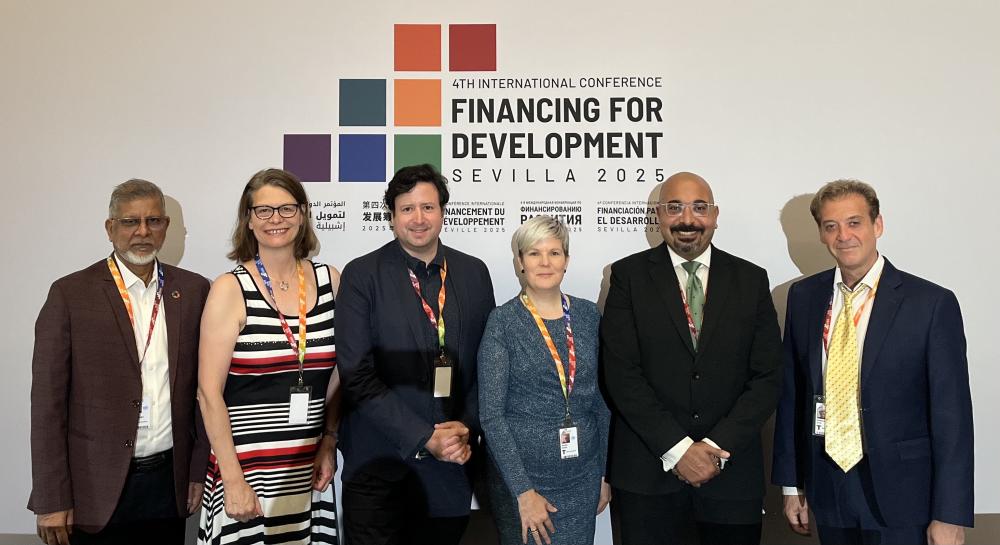
The third event focused on “Fostering Inclusive Green Finance” and was jointly organised with the Alliance for Financial Inclusion and the German Institute of Development and Sustainability. This FfD4 side event highlighted the importance of inclusive green finance policies for ensuring that also firms and households at the base of the economic pyramid will have the opportunity to invest in resilience and sustainable development. Well-designed inclusive green finance policies can drive a virtuous cycle of growing resilience. If economic actors at the margins of the financial system can afford the services necessary to insure themselves against shocks, invest in green technology and adapt to climate change and environmental degradation, they will increase their resilience.
Clients that are more resilient to climate-related and environmental shocks pose lower credit, market and liquidity risk for the financial institutions that serve them. Carefully articulated inclusive green regulations and policies can help reduce the vulnerability of a larger part of the economy to climate shocks.
A more resilient real economy in turn reduces the risks facing the financial sector, enhancing financial stability. Because this means higher risk-adjusted returns for financial institutions, inclusive green regulations and policies promise to be cost-effective. In the event, Professor Ulrich Volz discussed together with Chowdhury Liakat Ali, the Director of the Sustainable Finance Department of Bangladesh Bank; Walid Ali, the General Manager of the Sustainability Department of the Central Bank of Egypt; and Helen Walbey, the Lead of Global Partnerships at the Alliance for Financial Inclusion how financial authorities can promote inclusive green finance policies and showcased best practice and digital innovations.
Header image credit: Tânia Mousinho via Unsplash.