SOAS, UN University and ICEED launch AI hub to tackle global challenges


SOAS has launched a joint research and education hub with the United Nations University (UNU) and the International Council on Environmental Economics and Development (ICEED).
The initiative will form the UNU Hub on Artificial Intelligence for Climate, Governance and Culture. It will bring together global expertise to examine how artificial intelligence can address climate change, sustainable finance, governance, cultural heritage, wellbeing, resilience and preservation.
The UNU Hub, to be located at SOAS, will use an interdisciplinary approach to research how AI can be responsibly developed and applied to advance climate action, sustainable development, governance and culture.
The collaboration brings together the distinct strengths of each partner. SOAS as a renowned research university, UNU as the academic arm of the United Nations, and ICEED as an institute committed to solving challenges at the intersection of environmental economics and development.
Humanity stands at a pivotal moment for solving global development challenges. Efforts to solve the triple planetary crisis of climate change, pollution and biodiversity loss – and address the impact on governance and culture – are being hindered by a strained multilateral system and isolationist policies. At the same time, the explosive pace of innovation surrounding AI is opening vast opportunities for collaboration, education, and development solutions.
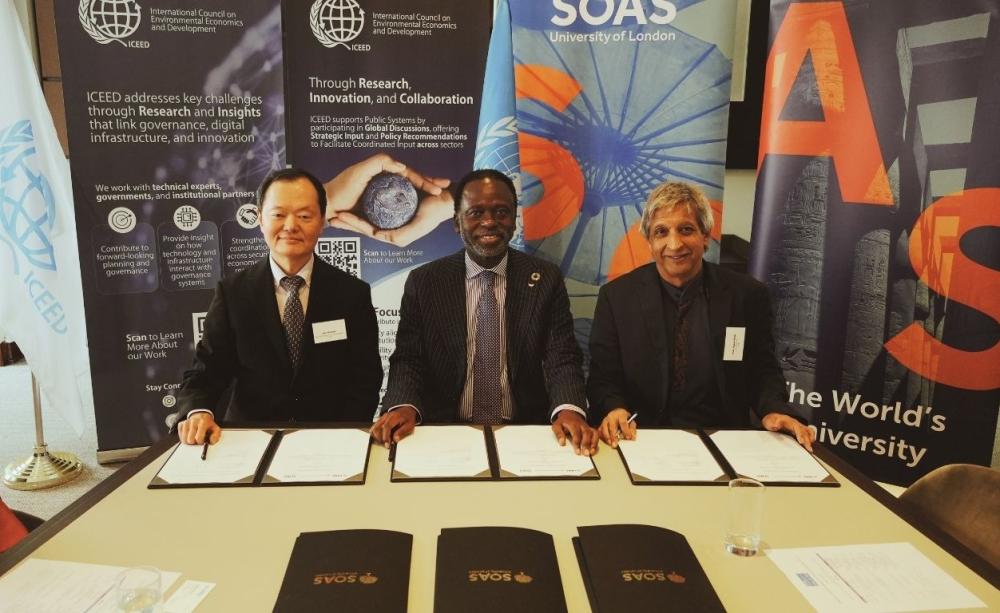
The UNU Hub aims to become a leading global centre for critical research on AI’s role in addressing major global challenges through four research clusters: climate finance, climate adaptation, governance, and culture. The UNU Hub will seek to disseminate its research through education and advocacy and outreach activities. The specific activities will include producing research reports, articles and policy pieces, integrating UNU Hub research outputs into SOAS curricula and relevant degree programmes, collaborative teaching and the development of teaching short courses, and designing tailored executive education programmes for industry, government, and civil society.
SOAS Vice-Chancellor Professor Adam Habib said: “The UNU Hub is one of the few applied AI research centres in the world that will address the environment, climate change, governance, culture and ethics. SOAS, as a university that specialises in humanities and social science, has repeatedly made the case for putting people at the heart of the development of AI. That is why our ambition for the UNU Hub is that it will make effective interventions in addressing the challenging global issues that are facing humanity. One of the biggest questions right now is about safety, and I hope with the UNU Hub that we can speak directly to these concerns. We very much look forward to developing our research, education and outreach in this field with the UNU and ICEED, and to see its real-world impact take effect.”
This collaboration brings together the distinct strengths of each partner. SOAS as a renowned research university, UNU as the academic arm of the United Nations, and ICEED as an institute committed to solving challenges at the intersection of environmental economics and development.
UNU Rector and Under-Secretary-General of the United Nations Professor Tshilidzi Marwala said: “Never before has technology had more potential to accelerate sustainable development. Yet, the unchecked or irresponsible use of artificial intelligence carries real risks of turning progress into new problems. As we work to solve interconnected global crises, our use of artificial intelligence must be researched, applied and governed to promote shared values, provide equal access to knowledge, and give voice to diverse cultures. This new UNU Hub will blend SOAS’s academic impact, ICEED’s public-private partnerships, and UNU’s research expertise across the multilateral system to produce innovative solutions and educational opportunities that advance efforts to use AI for good.”
ICEED Member of the Board of Directors Ken Kitatani said: "AI has become an integral part of the infrastructure through which global institutions learn, decide, and act. Harnessing its potential as it continues to shape economies and societal progress depends on how research, governance, investment, and implementation evolve as one unified system. The UNU Hub offers a platform for that convergence, advancing innovative ideas toward responsible, scalable, and globally transformative applications."
As well as shaping international policy, the UNU Hub will also work to identify the challenges associated with the use of AI, including ethical issues, economic implications, the governance and regulatory climate, and environmental impacts - and the possibilities of using data from as wide a range of sources as possible to help expand the effectiveness of AI tools.