Learning through objects: Bidriware in the SOAS Collections


SOAS Collections and Engagement Officer Lucy Kauser describes the history, production and use of bidriware, a distinctive metal-working tradition originating from India.
Among the many objects used for teaching and research at SOAS are two examples of bidriware. At first glance they appear quite different. One is a tall, elegant flask with a finely polished surface and delicate decoration. The other is a smaller vessel with a rougher texture, richly inlaid with golden and silver metals. Yet both were created using the remarkable bidri technique, a process that combines metallurgy, engraving and inlay to produce objects whose shining metallic decoration stands out dramatically against a deep black ground.
A teaching collection
The SOAS Collections are, above all, a teaching collection. Over many decades, objects and artworks have been acquired to support teaching, learning and research. Students encounter objects directly through handling sessions, workshops and seminars, using them to explore questions of material culture, craftsmanship, trade, collecting and museum practice.
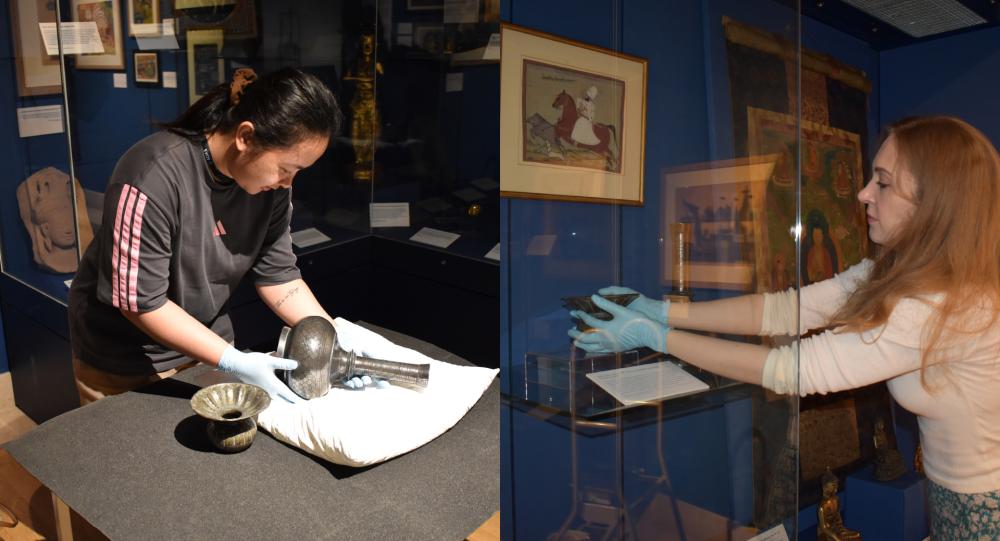
The two bidri objects discussed here entered the collection through a donation by G. Fidelfati via Professor Anna Contadini, who played an important role in developing and formalising the SOAS Collections. Today they continue to provide valuable opportunities for object-based learning, allowing students to engage with both the technical processes of manufacture and the wider histories of cultural exchange that these objects embody.
The origins of bidriware
Bidriware takes its name from the city of Bidar in present-day Karnataka, which emerged as an important centre of production, possibly under the Bahmani rulers of the Deccan.
Although Bidar is widely regarded as the birthplace of the craft, the precise origins of bidriware are uncertain.
Historical traditions and later scholarship have linked the technique to craftsmen arriving from Iran, Iraq or other parts of the Islamic world, while others have suggested that local traditions of metal inlay may also have contributed to its development. What is clear is that by the seventeenth century bidriware was already being produced and had become a highly valued luxury craft.
Production methods
Objects are first cast from an alloy consisting primarily of zinc, together with smaller amounts of copper. Once the casting has been shaped and polished, the surface is temporarily darkened using a solution of copper sulphate. Designs are then carefully drawn and then chiselled out. The engraved areas are inlaid with silver, brass, gold, or a combination of these metals.
The final stage is what gives bidriware its distinctive appearance. Craftsmen apply a blackening paste containing substances combined with a special kind of soil. This darkens the zinc alloy while leaving the inlaid metals bright, creating the dramatic contrast for which bidriware is known.
The SOAS Collections
The larger vessel in the SOAS Collections is a water flask with a rounded body and tall, narrow neck, originally fitted with a stopper or lid that is no longer present. Its surface is highly polished and decorated with exceptionally fine inlay work, probably combining silver wire with areas of sheet inlay to create intricate floral and geometric designs. The decoration is organised into horizontal registers of alternating motifs characteristic of bidriware ornament. Although the flask bears similarities to examples attributed to Purnea in Bihar, particularly in form and decorative treatment, these features are not exclusive to a single production centre and are representative of bidriware more broadly. Water flasks were among the many utilitarian and luxury objects produced in bidri, alongside hookah bases, ewers, trays, betel boxes and spittoons.
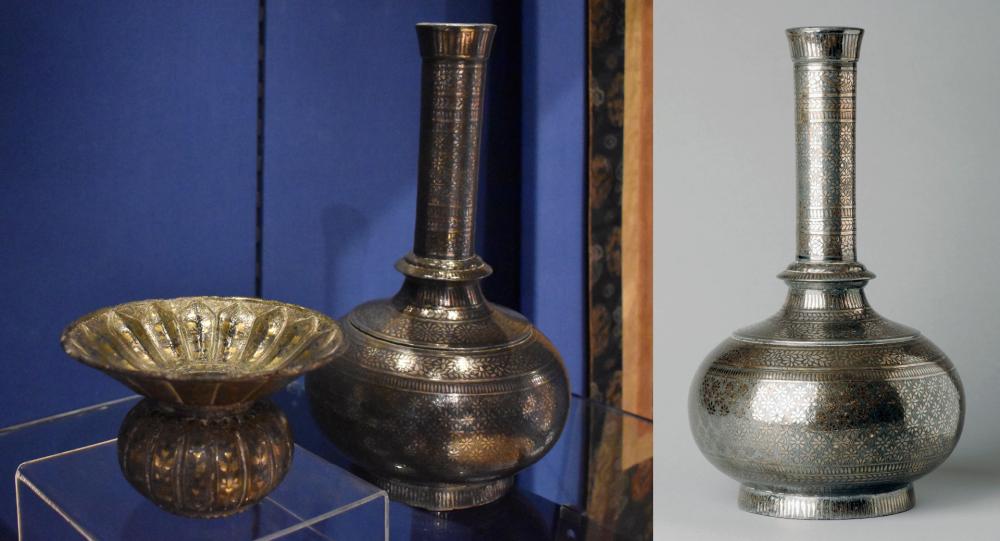
The second object, probably a small spittoon, is quite different from the first. Its decoration is dominated by broad areas of bright golden-coloured inlay, possibly brass or gold, complemented by smaller silver accents. The overall appearance is less highly polished than the flask, and the blackened surface is softer and less uniform in tone. Indeed, earlier SOAS documentation described the object as a ‘stone basin’. Like the flask, the object cannot be securely attributed to a particular workshop or production centre. Similar techniques were employed across a number of bidri-producing regions.
Protected status
Today, bidriware is protected through a Geographical Indication (GI) tag, granted in 2005 and recognising the craft's long association with Bidar in Karnataka. A GI tag is a form of intellectual property protection that links a product's identity and reputation to a particular geographical region and its traditional methods of production. In the case of bidriware, the registration recognises the importance of the distinctive blackening process through the application of soil from the area of Bidar Fort, which is said to have special properties.
This soil is a huge part of bidriware’s modern identity. However, the history of bidriware is more geographically complex than some modern definitions sometimes suggest. As the two SOAS examples demonstrate, bidri production flourished for centuries in a number of centres as well as Bidar, including Purnea, Murshidabad and Lucknow, each developing distinctive forms, decorative preferences and technical specialisms. While bidriware was once produced across a much wider geographical area, today the craft survives principally in Bidar, with a smaller tradition continuing in Hyderabad.
New audiences
The nineteenth century brought profound changes to these established systems of production. As courts such as Lucknow and Murshidabad declined under British colonial rule, artisans increasingly sought new markets. International exhibitions, including the Great Exhibition of 1851, introduced bidriware to British audiences, while institutions such as the South Kensington Museum (now the V&A) actively collected examples of Indian craftsmanship.
The growth of museums in Britain created new audiences for these objects and helped shape how Indian decorative arts were understood, classified and displayed.
Although the early histories of the two SOAS objects remain unknown, they form part of this wider story of movement and collecting. Their presence at SOAS reflects the global circulation of Indian artworks and craft objects during the colonial and postcolonial periods.
SOAS Gallery will be hosting a workshop on SOAS bidriware on 20th July, as part of the Object in Focus series at SOAS Gallery. To read more and register, visit the Gallery website.
References
Stronge, Susan. Bidri Ware : Inlaid Metalwork from India. [London]: Victoria & Albert Museum, 1985.
Lal, Krishna. Bidri Ware : National Museum Collection. New Delhi: National Museum, 1990.
Jagdish and Kamla Mittal Museum of Indian Art, and Jagdish Mittal. Bidri Ware and Damascene Work in Jagdish and Kamla Mittal Museum of Indian Art. Hyderabad: Jagdish and Kamla Mittal Museum of Indian Art, 2011.