-
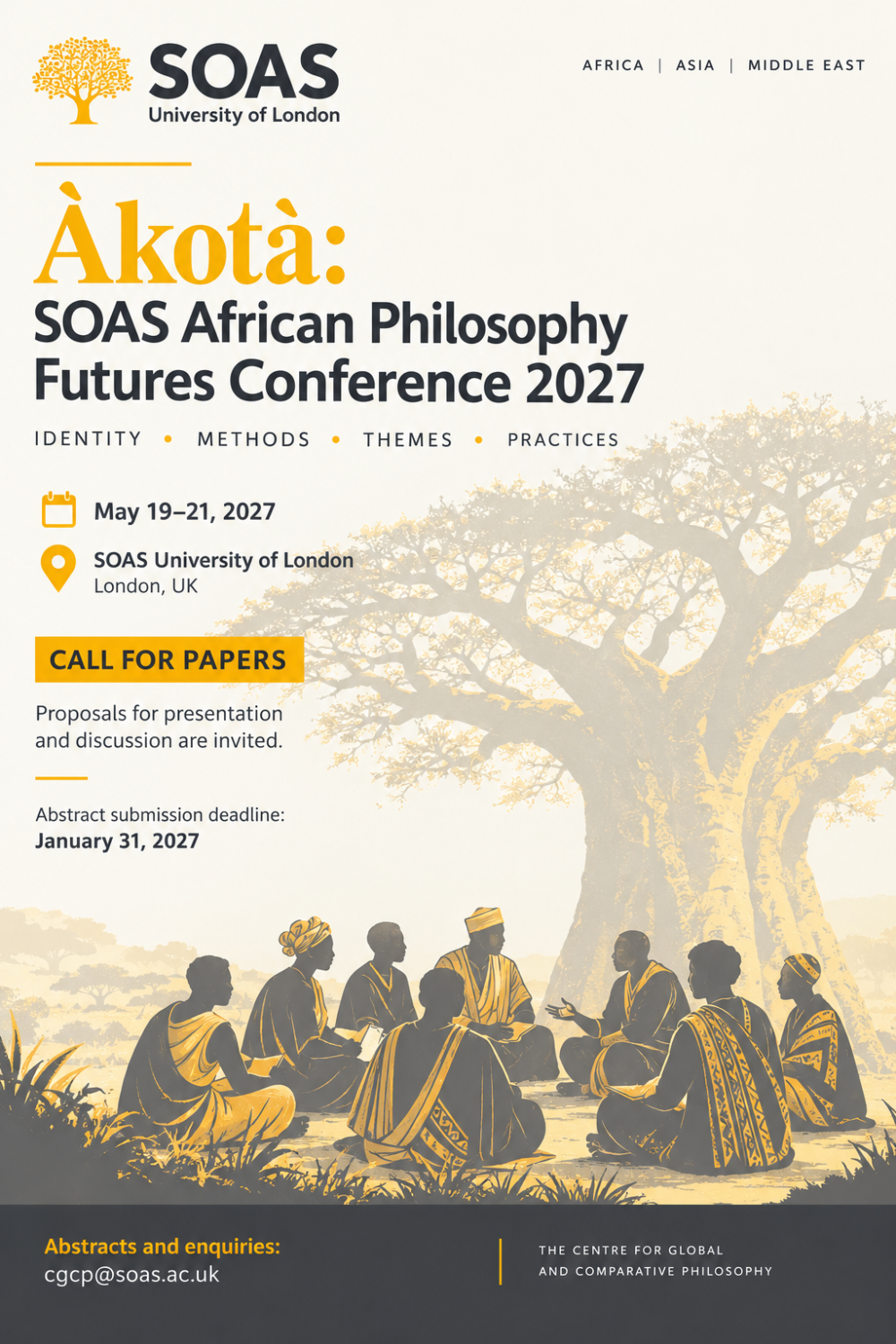
Àkotà: SOAS African Philosophy Futures Conference 2027: Identity, Methods, Themes and Practices

Key information
- Date
- to
- Venue
- TBC
About this event
Conference Structure
- Day 1: Identity, methods and approaches to doing African Philosophy.
- Day 2: Thematic and theoretical debates, including gender, disability, life's meaning, modes of being and knowing, moral theory, violence and suffering, personhood, and justice.
- Day 3: Applied African philosophy and its implications for issues such as AI, environment, health and wellbeing, mental health, politics, migration and education.
The Àkotà Forum
A daily collective deliberation bringing selected delegates together to discuss a shared theme and collaboratively develop a paper
Submissions for Presentation
- Abstract Submission Deadline: January 31, 2027
- Individual submissions: Maximum 250 words.
- Panel proposals: Maximum 1,000 words.
- Proposals reviewed within two weeks of receipt.
- No registration fee.
Submissions and enquiries:
Conference Description
African philosophy, as an intellectual, embodied and lived philosophical tradition drawn from textual and non-textual epistemic repositories, has generated rich and robust discourses and debates and contributed to the global dialogue on academic philosophical inquiry and its implications for lived experiences, social issues and debates, more prominently in the last eight or so decades.
African philosophy has contributed significantly to critically interrogating and reimagining the dominant philosophical canon and provided important and authentic insights into philosophy’s obligation to critically analyse and reshape human and nonhuman ecosystems in such areas as technology, politics, disability, environment, gender, Artificial Intelligence, education and justice. But there is much left to deliberate on, interpret, understand and interrogate in terms of identity and defining features, methods, theories, themes and focus, and practices and applications in relation to African philosophy. What is the future of this authentic African mode of inquiry as it continues to contend with itself, its othering and its place in the contest and context of the global philosophical tradition?
Proposals for presentation and discussion are hereby invited from African philosophers across the globe and philosophers from diverse philosophical traditions interested in engaging critically and constructively with the African philosophical tradition, for what promises to be a thrilling and lively international conference at the heart of London, in a space that has over the years become self-critically dedicated to understanding the world from the epistemic lenses of Africa, Asia and the Middle East, SOAS University of London.
The three-day Conference will focus on questions of identity, methods and approaches of doing African Philosophy (Day 1); thematic and theoretical considerations and debates, such as gender, disability, life’s meaning, modes of being, modes of knowing, moral theory, violence and suffering, personhood, and justice that centre on African philosophical traditions (Day 2); and applied African philosophy or the implications of African philosophy for practices and models concerning such spheres of social, scientific and technological life as AI, environment, health and wellbeing, mental health crises, politics, migration and education (Day 3). Proposals for panels on any aspect of these are also welcomed.
The highlight of each day of the conference will be the Àkotà Forum. Àkotà is a word from the ancient Kingdom of Benin in Southern Nigeria which literally translates as ‘coming together for deliberation.’ A carefully selected group of delegates will be asked to spend some time collectively deliberating on a theme and taking notes for the purpose of co-authoring a paper from the deliberation. Two volumes are planned to emerge from the conference, a journal special issue and an edited book. The collaboratively curated discourses will be published in these volumes alongside individually or co-authored papers selected and developed from presentations during the conference.
Conference poster