Development Minister sets out vision for global resilience at SOAS


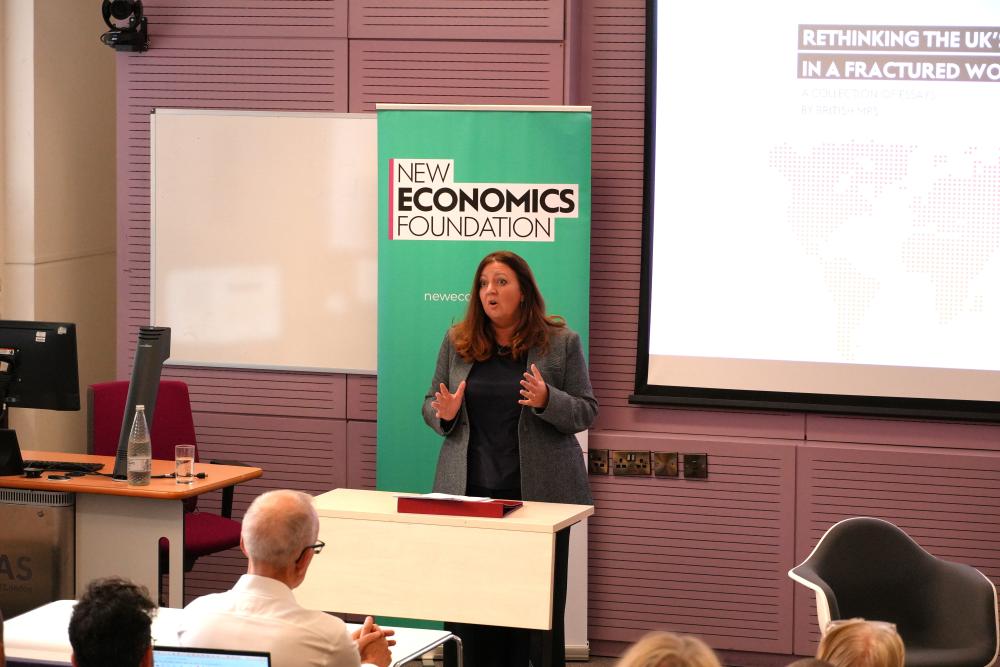
Kirsty McNeill, Minister for International Development and Africa, delivered a wide-ranging speech at SOAS this week, setting out a vision for a new era of international cooperation rooted in shared resilience, solidarity and mutual interest.
The event, hosted by the New Economics Foundation and SOAS, brought together policymakers, academics and members of the development and humanitarian community to consider how the UK can respond to global challenges including climate change, conflict, food insecurity and pressure on multilateral institutions.
It also marked the launch of a cross-party collection of essays titled Rethinking the UK’s role in a fractured world, offering progressive ideas to reset the UK’s international agenda ahead of the UK hosting the G20 in 2027.
The era of development is over and the era of mutual interest and shared resilience is upon us...
Pallavi Roy, Professor in Political Economy at SOAS and Deputy Dean Research Knowledge Exchange and Enterprise, College of Social Sciences, in her opening remarks, said: “In our work [at SOAS] today, we provide a unique perspective that in a delicious irony, inverts why SOAS was founded. But who we have become now helps us build a stronger, better Britain where our allies trust us to be true partners in progress. And I believe that is in keeping with the spirit of the collection of essays the Honorable Minister is about to launch.”
How we learn to live together
Kirsty introduced her speech as one about “how we learn to live together” warning “if we get this wrong, much darker days lie ahead. We are already seeing the warning signs.” But if we learn to live together well “we could be part of helping make life on earth safer, healthier and happier than ever before.”
Connecting global resilience to local communities, Kirsty argued that solidarity begins in places where people build relationships, mutual trust and a sense of common life. Drawing on examples from community clubs in Scotland and humanitarian work in Ethiopia, she said that concern for people overseas is strengthened when people feel rooted and connected in their own communities.
Global challenges are not experienced equally
Kirsty argued that the challenges facing the world are increasingly shared across borders, even when their impacts are not experienced equally, pointing to the effects of climate change, precarious work, violence against women and girls, and instability in global food systems.
She said the UK should use its diplomatic, development and humanitarian capabilities in support of both its values and national interest, but also warned that times had changed. In one of her central arguments, Kirsty suggested that the traditional language of “international development” no longer reflects the realities of a more interconnected world, where countries face shared risks across health, climate, economics, human security and food systems.
Kirsty advocated for thinking much harder about building resilience and managing shared risk to prevent crises becoming catastrophes was needed, and each requires a mindset well beyond “development” and certainly a toolkit much broader than Official Development Assistance.
A call to “club together”
“The era of development is over and the era of mutual interest and shared resilience is upon us,” she said, calling for a broader approach based on multilateral action, agile alliances and reform of global systems.
The speech concluded with a call to “club together” in response to global challenges, framing solidarity not as charity, but as a practical foundation for shared security in an increasingly uncertain world.
Kirsty was joined by the Chief Executive of NEF Danny Sriskandarajah for an open Q&A after the speech.