Mobile game that tackles descent‑based slavery to debut in schools across London


Dr Marie Rodet has joined the Social Impact Demonstrator (SID) programme, an accelerator that will support the pilot of her award-winning mobile game USAWA and companion tool USAWA AI in 10 secondary schools across London.
The initiative marks a first in the academic delivery of game-based learning designed to create social impact in communities across the capital. Through the collaboration between The Queen Elizabeth Olympic Park Innovation District and London Social Ventures, the SID programme supports academic-led innovations in moving from research into real-world application.
The programme provides an important opportunity to test how game-based learning and ethical AI can work together in real classrooms.
Set in an Afrofuturist world, USAWA introduces students to the histories and legacies of slavery in Africa through narrative gameplay. Drawing on research and real-life accounts of people affected by descent-based discrimination, the game is designed to encourage reflection and dialogue.
The game is complemented by USAWA AI, a dialogue-based tool that allows students to question a semi-fictional survivor of domestic servitude in Western Mali. The character is constructed from anonymised testimonies and historical research. Dr Rodet has also been working closely with SOAS IAA Fellow Max Musau to explore the project’s commercialisation and scaling potential.
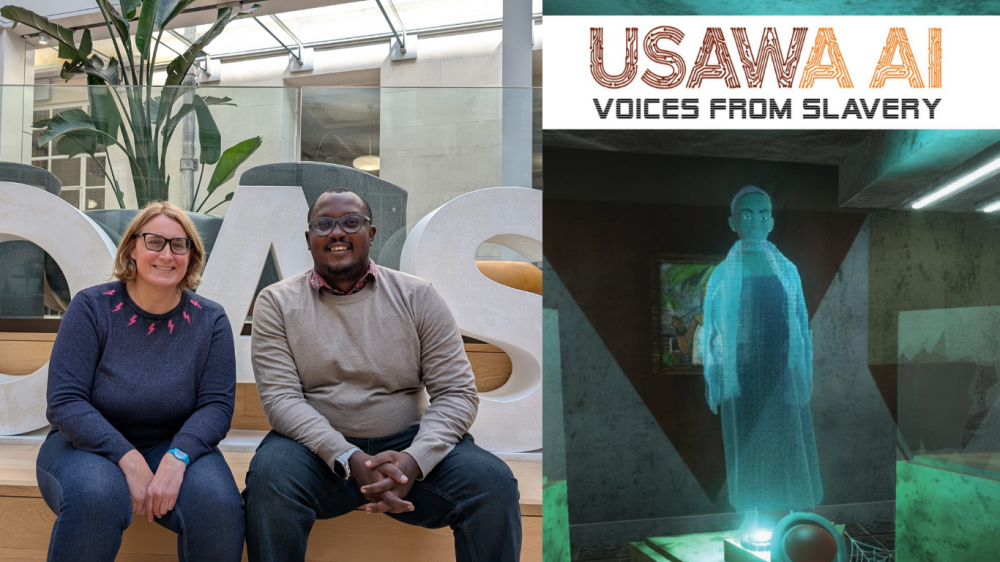
Speaking about the programme, Dr Rodet said: “The programme provides an important opportunity to test how game-based learning and ethical AI can work together in real classrooms. USAWA introduces students to the histories and legacies of slavery through narrative play, while USAWA AI supports critical dialogue and questioning.
Scaling this approach allows us to explore how digital tools can deepen historical thinking and open more thoughtful conversations about difficult histories in UK classrooms.”
Max added: "Our goal has been to build a system that doesn’t just inform but facilitates meaningful interaction with difficult histories. This pilot is critical to refining both the technology and its real-world application, as well as its distribution in UK schools.
It will help reshape how these histories are engaged with in the classroom, opening space for deeper dialogue and more thoughtful ways to move forward."
Developed through more than five years of research and impact funding — including support from ESRC GCRF, AHRC, SOAS IKE and HEIF, the project was co-created with partners including the Kenyan game studio Jiwe and the Malian NGO Donkosira - forming part of the broader Games for Thought initiative led by Rodet and supported by the London Social Ventures programme.
The 2026 SID programme brings together six social ventures from London universities. Workshops began earlier this month, supporting participants in preparation, innovation, growth and the delivery of social impact in local communities.