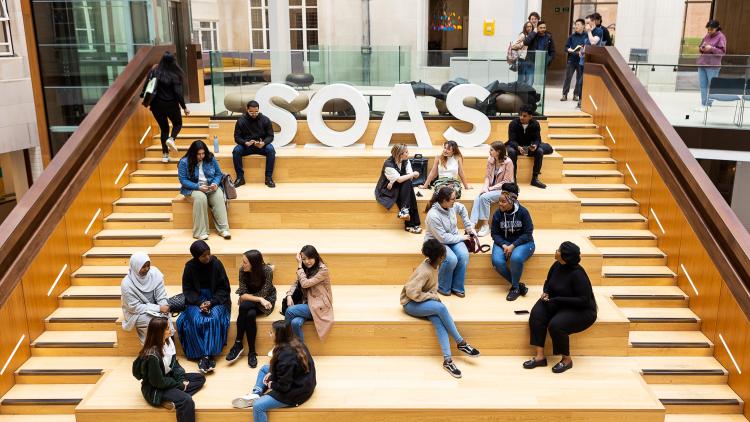
COP30 President and other thought leaders speak at SOAS during London Climate Action Week 2025


The SOAS Centre for Sustainable Finance hosted seven high-profile events during London Climate Action Week 2025, showcasing the Centre’s work on issues ranging from resilience and adaptation finance over financing just transitions to reversing the vicious cycle of debt, underdevelopment and environmental change.
The SOAS Centre for Sustainable Finance (CSF) hosted seven high-profile events during London Climate Action Week (LCAW) 2025. LCAW is an annual city-wide climate festival that harnesses the unique power of London for global and local climate action. It mobilises London’s unparalleled ecosystem of climate and non-climate organisations to accelerate global climate action.
CSF’s LCAW programme kicked off on Monday morning with an event on “A Green and Just Planet: G20 to COP30 Visions” with a keynote speech by COP30 President Ambassador André Aranha Corrêa do Lago who subsequently discussed with Mariana Mazzucato (Professor in the Economics of Innovation and Public Value at University College London), Amir Lebdioui (Associate Professor of the Political Economy of Development at University of Oxford) and Ulrich Volz (Professor of Economics and Director of the Centre for Sustainable Finance at SOAS) how to chart new economic development pathways that reconcile economic growth with ambitious climate action to safeguard a sustainable, equitable, and resilient future.
The event was jointly hosted by the SOAS Centre for Sustainable Finance, the Technology and Industrialisation for Development Centre at the University of Oxford, and the Institute for Innovation and Public Purpose at University College London. The discussion built on the recommendations put forward in the report A Green and Just Planet: A Framework for Governing Industrial and Financial Policy for a 1.5ºC World that was written by the Group of Experts to the G20 Taskforce on Global Mobilization Against Climate Change for the Brazilian G20 Presidency.
The referenced media source is missing and needs to be re-embedded.
On Monday afternoon the CSF hosted a discussion on “Strengthening the Public Development Banking Ecosystem to Drive Climate Action” that was co-organised together with UN Trade and Development (UNCTAD) with insightful contributions by Ijeoma Ozulumba (Executive Director, Finance & Corporate Services at Development Bank of Nigeria), Nicolas Picchiottino (Secretary General of the International Development Finance Club and Head of Public Development Banks at Agence Française de Développement), Maria Smith (Chief Impact Officer at British International Investment) and Diana Barrowclough (Senior Economist at UN Trade and Development). The panel was moderated by Professor Ulrich Volz.
On Tuesday morning, the CSF hosted a closed-door roundtable on private capital mobilisation together with the OECD and the Independent High Level Expert Group on Climate Finance bringing together thought leaders and practitioners for a focussed discussion of the institutional drivers shaping mobilisation efforts of development banks and development finance institutions.
Also on Tuesday morning, the CSF organised a discussion on “Unlocking the Triple Dividend for Resilient Growth” where Harald Heubaum (Senior Lecturer in Global Energy and Climate Policy and Deputy Director of the SOAS Centre for Sustainable Finance) presented his new study on this topic. This event was co-organised with the UK Department for Environment, Food and Rural Affairs and the World Resources Institute.
On Tuesday afternoon, the CSF hosted an engaged discussion on how bond markets can be employed to boost investment in climate resilience. Professor Ulrich Volz introduced the topic and moderated a panel discussion comprising Amal-Lee Amin (Managing Director and Head of Climate, Diversity and Advisory at British International Investment), Ulf Erlandsson (CEO and Founder of the Anthropocene Fixed Income Institute), Shakira Mustapha (Research Lead at Centre for Disaster Protection), Pablo Perez (Sustainable Capital Markets Structurer at BNP Paribas) and Simon Zadek (Founding Partner of Morphosis). This event was jointly organised with the Anthropocene Fixed Income Institute. Forbes magazine published an article on this event.
On Wednesday, the programme continued with a discussion on “Reversing the Vicious Cycle of Debt, Underdevelopment, and Environmental Change” moderated by María Fernanda Espinosa Garcés (Executive Director of GWL Voices & Co-Chair of Debt Relief for Green and Inclusive Recovery), Hannah Ryder (CEO of Development Reimagined), Sara Jane Ahmed (Managing Director and Finance Advisor to the Vulnerable Group of Twenty (V20) Ministers of Finance of the Climate Vulnerable Forum), Ritu Bharadwaj (Director of Climate Resilience, Finance and Loss and Damage at the International Institute for Environment and Development), Jamie Drummond (Founder of Sharing Strategies) and Ulrich Volz. This event was co-organised with the Debt Relief for Green and Inclusive Recovery project which is co-convened by CSF.
The seventh and final LCAW event organised by the CSF focused on “Green Energy Transition in Asia: Aligning Finance, Policy and Equity” with Shiezra Mansab Ali Kharal (Minister of State for Climate Change, Pakistan), Ma Jun (Chair, China Green Finance Committee; Director, Institute of Finance and Sustainability), Christoph Nedopil Wang (Director, Asia Institute, Griffith University), Suba Sivakumaran (Chief of the Financing for Development Section, UN ESCAP), Mustafa Hyder Sayed (Executive Director, Pakistan-China Institute) and Ulrich Volz. This event was jointly organised with the Griffith Asia Institute and the Pakistan-China Institute.
Header image credit: Giammarco Boscaro via Unsplash.