Learning otherwise: Gay School and the possibilities of radical pedagogies


Fran introduces Gay School, a pedagogical experimental community space for anyone who feels excluded from traditional education, especially those who may not have access to academic resources.
I turn to theory the way you turn to a wound, not to make it disappear, but to understand its depth.
In times of multiplying genocides, of dispossession unfolding in real time on our screens and in our bodies, I find myself asking: what is the point of theorising? What use is a concept, a framework, a beautifully crafted sentence, while people are being slaughtered? There is a real danger in theory, that it becomes a kind of alibi, a way of thinking about violence without ever being changed by it, an intellectual caress that keeps us safely distant from the injury. I stay vigilant against that. I stay cautious of any theory that abstracts the flesh into statistics, that lets us sit comfortably with ideas while our kin bleed.
The laceration and the language
Yet, I turn to theory to locate healing. Not because theory heals, I am not naive enough to believe that. Because theory, at its most alive, does something else entirely. It names the laceration. It traces the architectures of harm that are designed to feel inevitable, ordained. It hands us a language for our rage and our desire. I turn to theory in the attempt to recuperate a syntax capable of articulating deep wounds, rendering them visible.
Because theory, at its most alive, does something else entirely. It names the laceration.
To trace a geography of care that long before me, people whose lives were made disposable, have already charted. I return to a lineage of feminist, queer, decolonial thinkers who did not theorise from a safe distance but wrote from and for the wound. Thinkers who offered, in bell hooks' words, theory that could “speak directly to the pain that is within folks, and offer them healing words, healing strategies.”
At its most honest, theory is a manual of survival.
At its most honest, theory is a manual of survival. A cartography of mutuality and care moved by hauntologies of resistance that permeates the very air we breathe, the futures that the dead pressed into the present before they were taken.
To exist within the contradiction, between theory's limits and theory's necessity, is perhaps the whole point. Not trying to make sense of it all, but letting the tension unravel and guide us closer to what matters most: other lives (human and non-human) and their liberation.
Born in dissonance
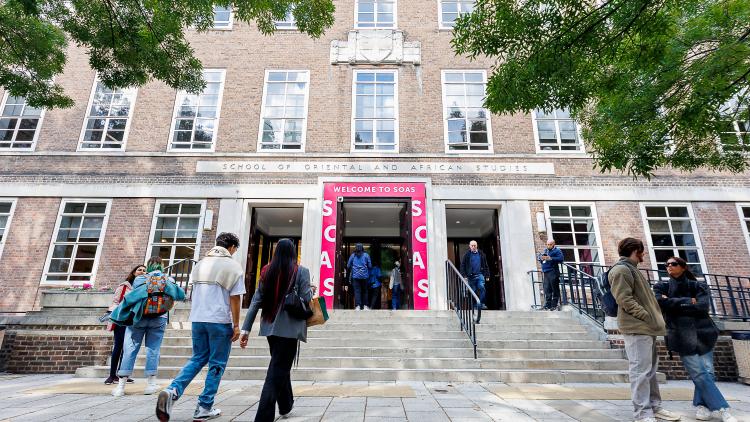
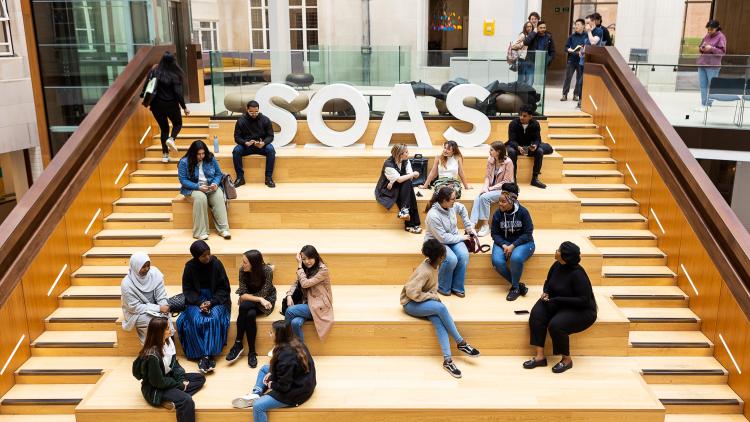
Gay School was born in that tension. Three of us sat in Gender Studies seminars at SOAS, having our worlds cracked open. It germinated when Dr. Abeera Khan asked us to imagine queer feminist utopias not as escapist fantasy but as a methodological orientation toward futures that could transform the present. The question that followed us out of that room was simple and vast: What happens when you take theory not as abstraction, but as instruction?
Gay School was born in that tension. Three of us sat in Gender Studies seminars at SOAS, having our worlds cracked open.
We felt a profound dissonance between what we were being given and what we were being prepared to do with it. Write reports for NGOs? Become diversity consultants for corporations that paint rainbow flags on their logos while exploiting workers globally? Our teachers helped us name the dissonance of learning about liberation within systems that continue to function on militaristic paradigms. They showed us how the university, which of all places should be a site of radical possibility, is also a site of violence, especially for bodies that were never meant to occupy those halls.
For black, brown, queer and trans people who know effacement as personal experience, the university offers a space where liberation might be spoken about, while systems remain carceral; where authority might be challenged but is ultimately reinforced; where learning about alternative modes of being comes at an extortionate cost, and then the border that was temporarily crossed is enforced again, when the programme ends and the visa expires.
What happens when you take theory not as abstraction, but as instruction?
Education is romanticised as an emancipatory project. But more often than not, it is about training the next labour force to reproduce the status quo, granting just enough "reformist" ideology to tinker at the edges, never to threaten the foundations. Even the radical university participates: demands for decolonial and queer feminist knowledge are too often absorbed in ways that ultimately reinforce institutional power, less funding, less authority, knowledge treated as supplementary rather than foundational.
We were lucky. Amidst the jarring dissonance, our teachers showed us otherwise and we felt the urge to share that inheritance with as many people as possible.
It’s giving Gay Robin Hood
Our goal was deceptively simple: to take the most potent, life-changing theories locked behind paywalls and bring them into community, to de-commodify knowledge and refuse the logic that says learning is only valuable when it can be exchanged for credentials or career advancement.
So we created our queer iterative classroom. A breathing, living space open to mould to the needs of our communities; where every session unfolds in two acts: the lesson and the assembly. The lesson looks like a seminar but refuses its hierarchies, we call jargon alerts when academic language becomes stupidly inaccessible, we pause to dissect it, we encourage people to fidget and doodle and write on tablecloths. The assembly moves us into the body: workshops, collective poems with all our hands on the same sheets, banners and collages, dancing, because we need it, to deal with daily tyrannies and to be better comrades to our kin.
We are nothing individually and personal progress is meaningless if it comes at the cost of someone else's life.
This structure refuses the fundamental lie of enlightenment modernity: that the mind is separate from and superior to the body, that reason is the only legitimate form of knowing, that those deemed closer to "instinct" and "flesh" — the black, the indigenous, the queer, the mad — are less than. Our theory is grounded in community. Our relationships are the rich soil from which we draw to cultivate epistemologies of resistance. We are nothing individually and personal progress is meaningless if it comes at the cost of someone else's life.
Make gay choices
We always close Gay School the same way. We say: Make gay choices.
It's partly a joke. Partly camp. Partly deadly serious. It is a call to choose solidarity over individualism, to act with intention rather than default, to refuse the terms that have been handed to us. And it is an invocation that, in José Esteban Muñoz’s words, we are “not yet queer, but we can feel it as the warm illumination of a horizon imbued with potentiality.”
That is what Gay School is: Bodies as evidence. Theory as instruction. The wound, and the cartography of care.
Not a destination. A direction. A practice of critical hope that insists: the world as it is, with all its violence and disposability, is not inevitable. Other worlds are possible. We can feel them. We can build fragments of them now. Gay School exists in the space between the world as it is and the world as it could be. Its eyes are fixed on a queer horizon; its feet are planted in the materialities of the now, in struggles over work, housing, borders, environment, genocide.
In the words of Hala Alyan: “to witness is to steward the truth. It is using the self — what it sees, what it knows — as evidence”. We are devoting ourselves and our work to truth-seeking, letting our bodies be evidence of the deep pain inflicted on our kin.
That is what Gay School is. Bodies as evidence. Theory as instruction. The wound, and the cartography of care.
Find out more
Gay School meets regularly in London. Sessions are free or low-cost, open to all, and run on principles of mutual aid and collective knowledge production. Follow the Gay School on Instagram and find out more at gay.school.lnd@gmail.com.