Head of Department of Economics
Department of Economics
MSc AI and Sustainability

You are viewing:
Key information

Key information
- Duration
- 1 year
- Start of programme
- September
- Attendance mode
- On campus
- Location
- On Campus
- Fees
-
Home: £12,965
International: £25,320 - Course code
- PSO-AISUST1FD, PSO-AISUST2PD
- Entry requirements
-
We will consider all applications with 2:2 (or international equivalent) or higher in any discipline that does not incorporate a strong data science component. In addition to degree classification, we take into account other elements of the application such as your supporting statement. References are optional but can help build a stronger application if you fall below the 2:2 requirement or have non-traditional qualifications.
Course overview
The MSc Artificial Intelligence (AI) and Sustainability at SOAS explores the complex and evolving relationship between AI technologies and environmental, socio-economic and macrofinancial sustainability. Designed for students who wish to engage critically with the links between AI and sustainability, the programme combines rigorous training in the data science foundations of AI with a deep understanding of its broader societal implications.
AI is reshaping economies and societies worldwide. The rapidly expanding AI infrastructure carries a substantial environmental footprint that exacerbates the environmental crisis, while the potential of AI to support more efficient use of natural resources remains uncertain. From a socio-economic perspective, AI is transforming labour markets with potentially adverse effects on inequalities, employment and the distribution of power. The rapid expansion of AI also raises pressing ethical issues that need to be assessed through a social justice lens. At the macrofinancial level, the surge in often debt-financed investment in AI technologies may drive economic growth in the coming years, but can also lead to financial bubbles and generate financial instability. Crucially, all these implications of AI for sustainability vary significantly across regions and countries, shaped by local economic, social, environmental and institutional contexts.
Drawing on SOAS’s world-leading research and distinctive regional expertise, the programme equips students to engage critically with cutting-edge academic and policy debates on AI and sustainability. Alongside this critical perspective, students gain hands-on experience with machine learning and other data science methods through the analysis of real-world datasets and applications. This integrated approach – combining technical skills, sustainability analysis, and a global, context-sensitive perspective – prepares graduates to play a leading role in addressing sustainability challenges in the age of AI.
Why study MSc AI and Sustainability at SOAS?
- SOAS is ranked top 25 in the UK for Economics (QS World University Rankings 2026).
- You will have access to the Centre for Sustainable Finance, the Centre for Sustainable Structural Transformation and the Centre for AI Futures.
- You will obtain transferable analytical skills that are essential for careers in businesses, financial institutions, international organisations, government agencies and non-government organisations, in particular in positions that require coding skills and a critical understanding of social and environmental sustainability challenges in the era of AI.
- Direct engagement with world-leading research: students conduct supervised dissertation research and can apply for part-time research assistant roles on faculty projects. You can also access the department’s seminar series, and events from the Centres for Sustainable Finance, Sustainable Structural Transformation, and AI Futures.
Global partnerships and internships
Students of the programme are eligible to apply for a co-supervised dissertation, collaborating with members of the Department of Economics and leading experts from international organisations. These organisations include the World Bank, the International Trade Centre (ITC), the United Nations Industrial Development Organisation (UNIDO), the United Nations Conference on Trade and Development (UNCTAD) and the International Labour Organisation (ILO).
Students are also eligible for 3-month remote internships at the World Bank for the period after the submission of the dissertation (i.e., after mid-September).
Study Tours
All postgraduate students can take part in our Study Tours and explore the world. Destinations include New Delhi, Lahore, Seoul, Luang Prabang, Almaty, Bishkek, Kigali, Johannesburg, and Doha. For more information, see our Study Tours page.
Structure
The MSc programme includes a supervised research project (60 credits), four compulsory taught modules (15 credits each), and four guided optional modules (15 credits each) selected from a pool of available modules. The modules are delivered through lectures, seminars and workshops.
Compulsory
Compulsory - Research Project
Guided option
Teaching and learning
Full or part-time study
The MSc programme is taught over a period of 12 months of full-time study or 2 years of part-time study. For 2 year study, you will study four modules each year, normally completing a dissertation in the second year.
Lectures
Most modules involve a 50-minute lecture as a key component.
Seminars/workshops
In seminars and workshops, students actively engage in hands-on exercises, explore case studies, and contribute to structured group discussions that deepen their understanding of the material and encourage critical reflection.
Research Project
A significant part of the work for the degree is devoted to the completion of a 10,000-word Research Project that can focus on theoretical or applied issues.
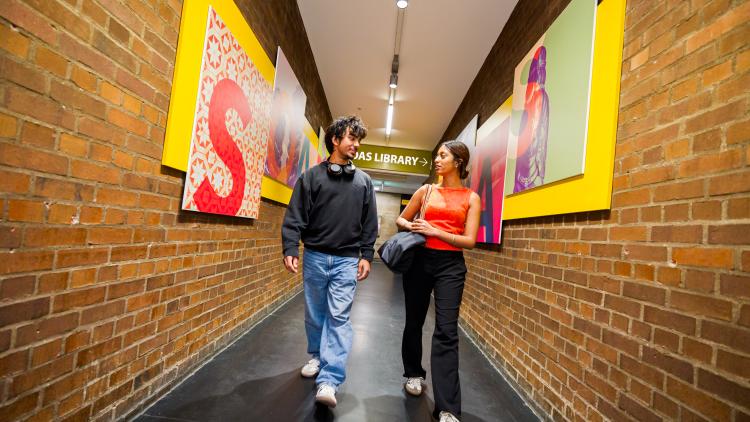
SOAS Library
SOAS Library is one of the world's most important academic libraries for the study of Africa, Asia and the Middle East, attracting scholars from all over the world. The Library houses over 1.2 million volumes, together with significant archival holdings, special collections and a growing network of electronic resources.
Scholarships
| Title | Deadline date |
|---|---|
| SOAS New Programme Scholarships |
Employment
The MSc AI and Sustainability is ideal for students who wish to obtain coding skills, apply data science techniques and develop a social science expertise on the analysis of environmental and social sustainability challenges in the era of AI. The programme provides a gateway to job opportunities in private companies, the government sector and international organisations. The advanced nature of the programme also serves as an excellent foundation for PhD studies.