Lecturer in Development Economics
Department of Economics
BA Economics

You are viewing:
Key information

Key information
- Duration
- 3 or 4 years
- Start of programme
- September
- Attendance mode
- Full-time
- Location
- On Campus
- Fees
-
Home: £9,790
International: £23,780 - Course code
- L102
- Entry requirements
-
A levels: ABB
Contextual: BBB
Applicants without A-level Maths (or equivalent) must have a minimum of grade B in GCSE Maths (or grade 6 in the new structure).
-
See undergraduate entry requirements and English language requirements for international and alternative entry requirements.
Course overview
The BA Economics degree will provide you with training in microeconomics, macroeconomics and quantitative methods that will enable you to pursue a successful career in an economics-related profession or to go on to postgraduate work.
BA Economics offers ample flexibility to the quantitative modules students can select, including a pathway to graduate with a BSc Economics degree.
Students will be given guidance on module selections and transfer opportunities between programme structures throughout their degree, including those aiming to graduate with BSc Economics. Moreover, the SOAS Economics department is distinctive in offering a pluralist and critical approach to economic theory, policy and real applications.
The Department of Economics is one of the country's leading departments specialising in political economy and heterodox approaches to economics as well as in the economics of development. Research and teaching is pursued on a variety of topics and is unique in its depth and range of regional and specialised coverage including topics from contemporary banking and finance the economics of the environment, gender economics, global economic theory, as well as the economic development of a variety of regions from Japan to the Middle East.
Why study Economics at SOAS?
SOAS is ranked top 25 in the UK for Economics (QS World University Rankings 2026).
Year in Industry
This programme offers a professional placement opportunity designed to improve your employability and put you in a better place for life after university. A professional placement is a great first step to getting necessary work experience and securing the career you want.
During your third year, you will work with a business or organisation and apply the knowledge you've learnt on your course in the workplace. You’ll develop skills like planning, problem-solving, decision making and project management, while getting first-hand experience on how a professional organisation works.
Please note that placement opportunities are organised by the student. If a placement is not found, you will be transferred onto the standard 3-year programme of study.
Study Abroad
Students are able to apply for the optional year abroad in their second year of studies at SOAS. Students will be invited to information sessions about how to apply during their second year of studies by the Study Abroad team. Student applications are considered on academic merit and a personal statement and are subject to availability. Students need to have achieved 55% or higher in their first year of studies to be eligible. For further details, visit the Study Abroad section of our website.
Degree combinations
Key information set data
Structure
Students take 120 credits composed of core, compulsory and optional modules.
- Core modules: These are mandatory and must be passed in the year they are taken before the student can progress to the next year.
- Compulsory modules: These are mandatory but in the case of a failure, students may carry this into their next year provided that they retake and pass the failed element or exam.
- Optional modules: These are designed to help students design their own intellectual journey while maintaining a strong grasp of the fundamentals.
Students who wish to graduate with a BSc Economics degree have to make sure to include and successfully complete Mathematics for Economists and Econometrics as part of their degree
Important notice
The information on the website reflects the intended programme structure against the given academic session. The modules are indicative options of the content students can expect and are/have been previously taught as part of these programmes.
However, this information is published a long time in advance of enrolment and module content and availability is subject to change.
Year 1 - Core
Year 1 - Compulsory
Year 1 - Guided options List 1
Student may select 30cr from List 1 OR 30cr from List 1 plus 15cr from Languages OR 15cr from List 1 plus 15cr from Languages
Year 2 - Compulsory
Year 2 - Guided options - List 2
Up to 30 credits from List 2
Year 3 - Compulsory
Year 3 - Guided options
60-90 credits from from list 2, 3A or 3C
Year 3 - Guided options - List 3B
Up to 60 credits from List 3B
Teaching and learning
Our teaching and learning approach is designed to support and encourage students in their own process of self-learning, and to develop their own critical grounds of the economics discipline.
Contact hours
All full-time undergraduate programmes consist of 120 credits per year, in modules of 30 or 15 credits. They are taught over 10 or 20 weeks. The programme structure shows which modules are compulsory and which optional.
As a rough guide, 1 credit equals approximately 10 hours of work. Most of this will be independent study. It will also include class time, which may include lectures, seminars and other classes. Some subjects, such as learning a language, have more class time than others. In the Department of Economics, most undergraduate modules have a two-hour lecture every week. Some, but not all, also have a one-hour seminar or tutorial every week.
Modules
Teaching combines innovative use of audio-visual materials, practical exercises, group discussions and conventional lecturing. Modules are taught through a combination of lectures and tutorials, usually a two-hour lecture and an one-hour tutorial weekly. Tutorials are sessions in which students are expected to take lead in discussions and/or present reports or presentations or solve problem sets and applied exercises in quantitative modules. Assessment of most modules is through a combination of written examination and course works.
Learning resources
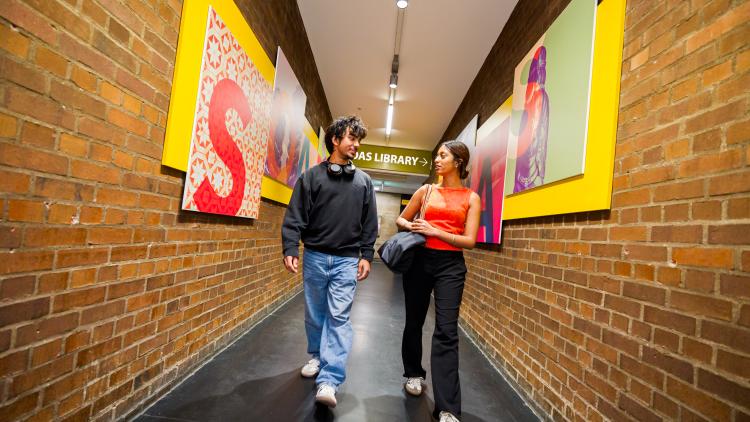
SOAS Library is one of the world's most important academic libraries for the study of Africa, Asia and the Middle East, attracting scholars from all over the world. The Library houses over 1.2 million volumes, together with significant archival holdings, special collections and a growing network of electronic resources.
Fees and funding
Fees for 2026/27 entrants per academic year
| Programme | Full time | |
|---|---|---|
| UK students | Overseas students | |
| BA, BSc, LLB | £9,790 | £23,780 |
| BA/BSc Language year abroad | £1,425 | £11,770 |
| BA/BSc Year in Industry | £1,425 | £1,425 |
For full details, see undergraduate fees.
Employment
Economics graduates leave SOAS with a solid grounding in statistical skills and an ability to think laterally, take a global perspective, and employ critical reasoning.
Recent graduates have been hired by:
- Bain & Co
- Barclays
- Bank of America
- Cabinet Office
- Deloitte
- Ernst & Young
- NHS England
- United Nations High Commissioner for Refugees (UNHCR)
- Foreign and Commonwealth Office
- Department for Business, Energy and Industrial Strategy
- HSBC
- National Institute of Public Finance and Policy, New Delhi
- UK Civil Service
- University of Bayreuth
- HM Treasury
- Department for International Development
- PwC
- UNDP
- King’s Investment Fund
- KPMG
- Foreign and Commonwealth Office
- The World Bank
- EY
- British Chamber of Commerce
- Oxfam
- RBS
Find out about our Careers Service